What a cash on delivery order costs a store in Saudi Arabia, the UAE and Egypt, what a refused parcel costs, and the checkout rules that keep COD from eating the margin.
A Saudi store that ships with Salla's courier labels pays SAR 8 plus VAT for every order the courier collects in cash. That fee sits on Salla's own help page, next to a cap of SAR 1,000 per COD order. In Egypt, Bosta's published price list charges EGP 97 to deliver a small parcel in Cairo and EGP 87 to bring it back when the buyer refuses it.
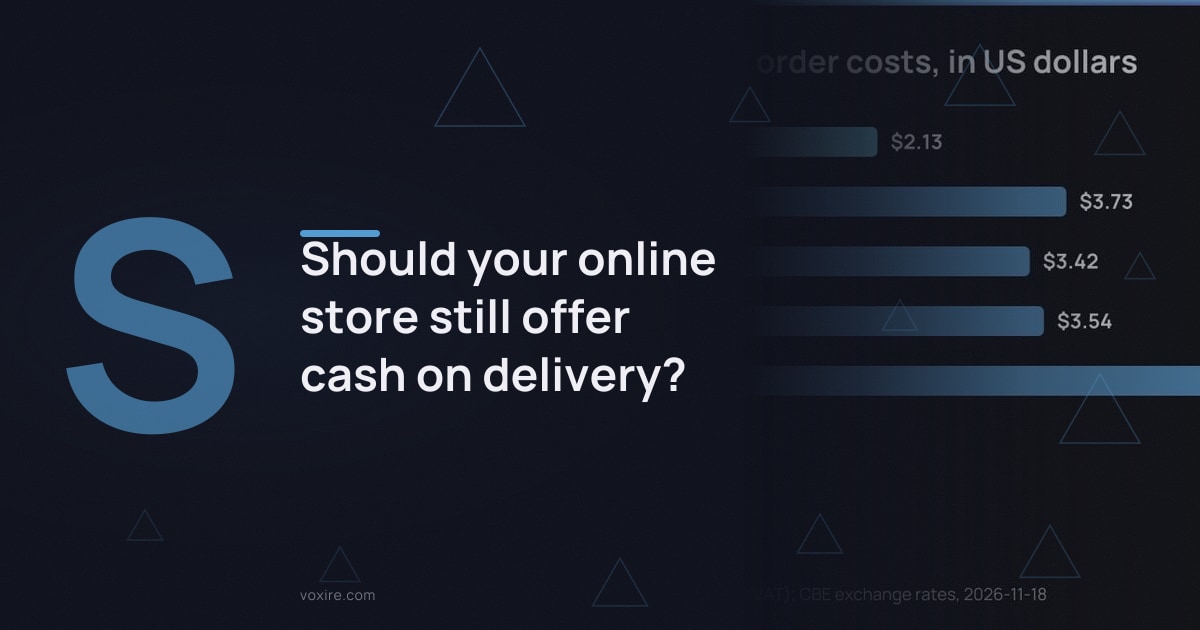
At the Central Bank of Egypt's rates for 18 November 2026, those are about $2.13, $267, $1.80 and $1.62. Each number is small. The trouble starts when a refused parcel pays both legs and earns nothing. This post prices cash on delivery for stores selling in Saudi Arabia, the UAE, Egypt, Jordan and Lebanon, and shows how to keep it without letting it set your margins.
How does cash on delivery work for an online seller?
For an online seller, cash on delivery works like this: the courier collects the money at the door and pays you later, minus its fee. On Salla's courier labels, collected cash is transferred on Sundays and Wednesdays, and each invoice covers orders completed the week before. Until then you carry the stock, the shipping and the refusal risk.
So COD is a payment method and a credit decision at once. You ship goods to someone who has paid nothing, and you trust the courier to hold the cash for you. That changes three things in the business: cash flow, shipping cost per sale, and how many parcels come back unopened. If you are still choosing a platform, our guide to starting an online store covers the setup before any of this.
Search the question from Riyadh and Google's summary explains the steps well. It then stops at the courier keeping its service fees, without naming a single one.
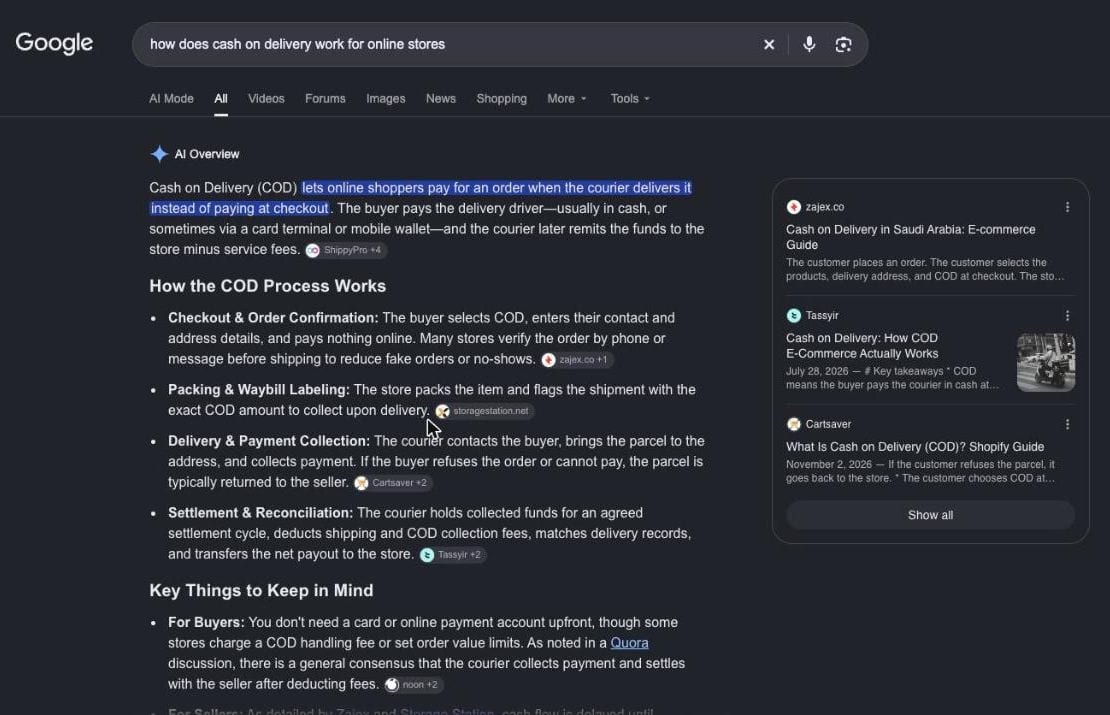
Google results for how cash on delivery works for online stores, searched from Saudi Arabia on 2026-11-18.
How much does a cash on delivery order cost the store?
A cash on delivery order costs a Saudi store about SAR 8 to SAR 14 before VAT, on top of shipping. Salla's help page lists AyMakan's COD fee at SAR 8 per order and SMSA's at SAR 8 plus 2% of the order value. On a SAR 300 order, SMSA takes SAR 14, about $3.73 at CBE rates.
| Market and provider | COD charge | COD order limits | When the cash moves |
|---|---|---|---|
| Saudi Arabia, Salla labels via AyMakan | SAR 8 per order before VAT ($2.13) | SAR 20 to SAR 1,000 ($5.33 to $267) | Sunday and Wednesday transfers |
| Saudi Arabia, SMSA via Salla labels | SAR 8 + 2% of the order before VAT | SAR 20 to SAR 1,000 | Sunday and Wednesday transfers |
| Saudi Arabia, noon marketplace | SAR 19 ($5.06), paid by the buyer | Up to SAR 6,500 ($1,733) | Not published |
| UAE, noon marketplace | AED 13 ($3.54), paid by the buyer | Up to AED 6,500 ($1,770) | Not published |
| Egypt, Bosta pay as you go | EGP 97 Cairo delivery ($1.80), EGP 87 return ($1.62) | noon Egypt caps COD at EGP 25,000 ($465) | Daily cash-out offered |
Source: Salla Help Center, noon Help, Bosta pricing and CBE exchange rates, read 2026-11-18
The table shows who pays. On Salla, the courier fee is charged to the merchant, and you choose what the buyer sees: charge more than the courier and the difference lands in your wallet, charge less and it leaves your balance, per the same Salla page. A marketplace bills the buyer directly. noon adds SAR 19 in Saudi Arabia and AED 13 in the UAE to every COD checkout.
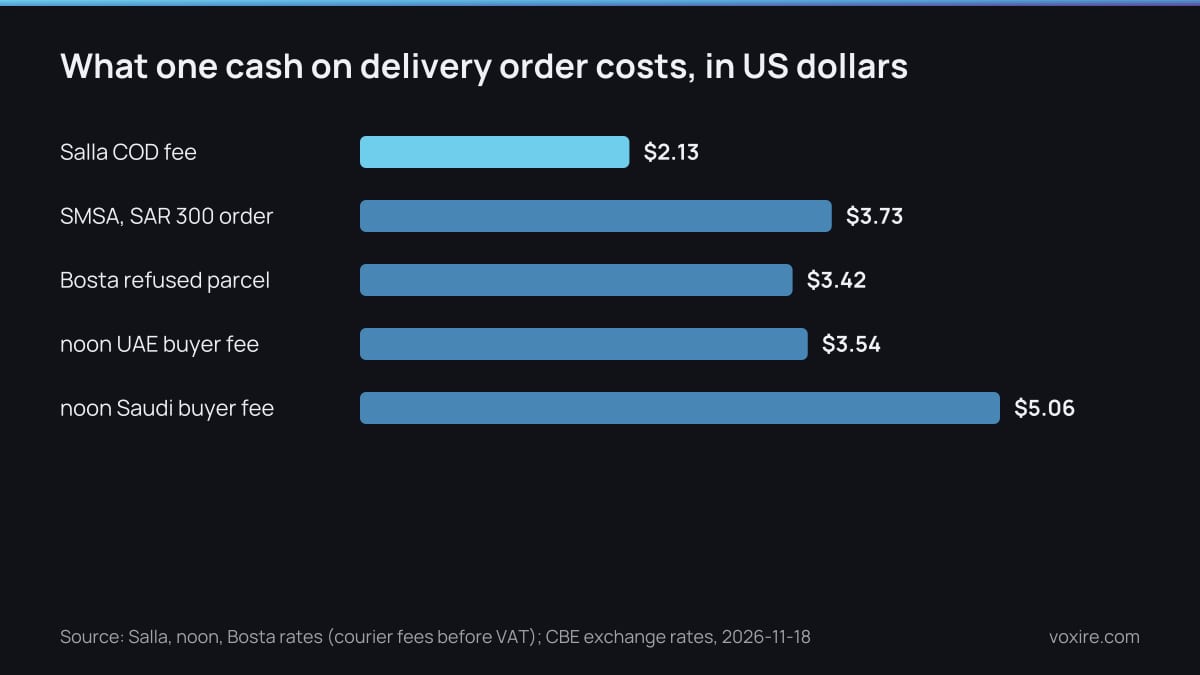
Courier and marketplace COD charges converted at CBE rates for 2026-11-18. Courier fees exclude VAT.
Who pays shipping on COD?
On COD, the store pays the courier for both delivery and collection, then decides how much of it to pass to the buyer. Bosta bills an Egyptian merchant EGP 97 per small Cairo delivery before VAT, whatever the payment method. Salla lets a Saudi store set its own COD surcharge above or below the courier's SAR 8, per its help page.
A visible COD fee is the cheapest nudge toward prepaid. A buyer who sees SAR 19 added at checkout, as on noon's Saudi store, has a reason to switch to a card. Compare the store's own cost: Telr's Saudi pricing charges 1% per mada sale, so a SAR 300 order paid by mada costs SAR 3 in fees against SAR 14 for COD through SMSA. Our Gulf payment gateway fees comparison prices the prepaid side in full.
What happens when a COD buyer refuses the parcel?
When a COD buyer refuses the parcel, the store pays both courier legs and earns nothing: EGP 184 before VAT in Cairo on Bosta's list. Bosta charges EGP 97 to deliver a small parcel and EGP 87 to return it, about $3.42 together at CBE rates. The product also sits in a van for days instead of on your shelf.
Run it over a month. Say a Cairo store ships 200 COD orders and 30 come back, an assumption to replace with your own courier report. Those 30 refusals cost 30 times EGP 184, or EGP 5,520, about $103 at CBE rates on Bosta's pay as you go prices. That is shipping spent on sales that never happened, before any staff time.
What are the disadvantages of Cash on Delivery?
The disadvantages of cash on delivery are slower cash, refused parcels and order caps that block larger baskets. Salla's courier labels cap a COD order at SAR 1,000, about $267, and hide COD below SAR 20, per Salla. Marketplaces cap higher: noon stops COD at SAR 6,500 in Saudi Arabia and AED 6,500 in the UAE.
The rest of the list is operational:
- Cash arrives late. Money collected this week reaches you after the next transfer day, and Salla warns that bank timing can add to it.
- Refusing is free for the buyer. Someone who paid nothing loses nothing by saying no at the door. noon restricts customers who hold several pending COD orders for this reason.
- Cash handling. Couriers carry change, or they do not, and every dispute about the amount lands on your support line.
- Exclusions. noon offers no COD for locker deliveries or gift addresses. A store of your own needs the same rules written down.
Why do shoppers still pick cash when most payments are electronic?
Shoppers still pick cash because it removes the risk of paying a store they do not know yet, even where cards dominate. In Saudi Arabia, electronic payments made up 85% of retail payments in 2025, up from 79% in 2024, according to the Saudi Central Bank. That figure covers all retail, shops included, not online checkouts alone.
So the national figure does not tell you how many of your own buyers will choose COD. Your checkout data does. Split your recent orders by payment method, then by new and returning customer. Returning buyers already trust you, and they are the easiest group to move to prepaid.
Lebanon sits at the far end of the region. Card trust there is still low after the banking crisis, and COD remains the default for most small stores. A Lebanese store selling into the Gulf has to run both models at once, which is one more reason to make COD a rule set rather than a switch.
How do you limit cash on delivery without losing orders?
Limit cash on delivery with rules instead of removing it: a minimum and maximum order value, a visible COD fee, and no COD for repeat refusers. Salla supports all three, including a SAR 20 floor and hiding COD from customers blocked by other Salla stores. A custom store needs the same rules built in.
When Voxire builds a store for a Gulf or Egyptian market, COD is a set of rules in the checkout, not one switch:
- Confirm before dispatch. Every COD order gets a WhatsApp message with the total, and an unconfirmed order does not ship.
- Cap by basket and by customer. COD appears only inside the value range you set, and disappears for a phone number with a past refusal.
- Price the choice. The COD fee shows at checkout, next to mada, Apple Pay and cards with no fee.
- Report it weekly. COD share, refusals and cash still held by the courier sit on one screen, so the cost is visible.
A slow checkout pushes buyers toward the option with the least typing. Our mobile speed audit of online stores found none of the stores we tested loading fast on a phone. Our web development service covers the checkout build, and the e-commerce development page lists the store work around it. Keep COD for the buyers who need it, and stop paying couriers for orders nobody meant to receive.
What should you actually do this week?
This week, pull your COD numbers, price one refused parcel, and set a COD cap and fee. Use your own courier's published rates, such as Salla's SAR 8 per order or Bosta's EGP 87 return, so the math is yours. Then change one rule and watch it for a month.
- Export the last three months of orders and mark each one COD or prepaid, delivered or refused.
- Multiply the refusals by your courier's delivery price plus its return price.
- Set a COD floor and ceiling at checkout, close to your average basket.
- Show the COD fee, and list mada, Apple Pay and cards first.
- Send a WhatsApp confirmation for every COD order before it leaves the warehouse.
Sources
- Saudi Central Bank: e-payments account for 85% of retail payments in 2025, read 2026-11-18
- Salla Help Center: cash on delivery with Salla shipping labels, read 2026-11-18
- noon Help: How does Cash on Delivery work?, read 2026-11-18
- Bosta Egypt: shipping prices, read 2026-11-18
- Central Bank of Egypt: exchange rates, read 2026-11-18
- Telr: Saudi Arabia pricing, read 2026-11-18
Need cash on delivery rules built into your checkout?
We build stores for Saudi, Emirati and Egyptian buyers with COD caps, WhatsApp confirmation and a prepaid-first checkout. Tell us your courier and your refusal rate, and we will show you what the rules save.
→ E-commerce Development → Get a Free Quote → Chat on WhatsApp
Enjoying this article?
Enter your email and get a clean, formatted PDF of this article: free, no spam.
Voxire
Web Development
Custom websites, Next.js and React applications, and the engineering decisions behind sites that stay fast under real traffic. Core Web Vitals, headless CMS choices, migrations, and what performance work is actually worth paying for.
Learn more