Starting an online store in Lebanon in 2026 requires navigating specific local challenges: limited payment gateways, logistics considerations, and a market that shops across WhatsApp, Instagram, and traditional websites. This guide covers what actually works in the Lebanese context.
Starting an online store in Lebanon in 2026 requires navigating specific local challenges: limited payment gateways, logistics considerations, and a market that shops across WhatsApp, Instagram, and traditional websites. This guide covers what actually works in the Lebanese context.
What does it actually take to sell online in Lebanon in 2026?
Lebanon's e-commerce market has matured significantly since 2020. Consumers are comfortable buying online, mobile shopping dominates (over 75% of Lebanese online purchases happen on mobile), and a generation of shoppers has grown up using Instagram and WhatsApp as primary discovery channels.
But Lebanon's online selling environment has unique characteristics that any new store needs to account for:
Payment is the biggest challenge. Traditional credit card penetration in Lebanon is lower than regional averages, and the banking crisis created additional complications. Cash-on-delivery (COD) remains the dominant payment method for most Lebanese online orders. You need to plan your business model around COD as a primary option, not a fallback.
Logistics require local knowledge. Lebanon does not have a single dominant last-mile delivery network the way larger markets do. Options include established local couriers, newer tech-enabled delivery startups, and your own delivery operation. Your choice affects cost, coverage, and the customer experience significantly.
The "informal" channel matters. Many Lebanese consumers discover and purchase products through Instagram DMs and WhatsApp conversations, not through formal checkout flows. Your store needs to capture this traffic and convert it: whether through a formal website, a WhatsApp catalog, or both.
Choosing your e-commerce platform
For most Lebanese businesses launching their first online store, Shopify is the most practical choice in 2026. It handles the technical infrastructure, has strong mobile performance out of the box, integrates with local payment gateways, and has a large ecosystem of apps and agencies who know the platform. See also: How to Start an Online Business in Lebanon for the broader business-launch playbook beyond the e-commerce platform choice.
WooCommerce (WordPress) is a strong alternative if you already have a WordPress site, want full control over your data, or have a developer comfortable with PHP. The total cost of ownership is typically lower if you have technical support, but higher if you are paying for maintenance and troubleshooting.
Custom-built stores using React and Next.js make sense for businesses that need specific functionality not available in Shopify or WooCommerce, or that expect very high transaction volumes. The upfront cost is higher but the long-term scalability and performance are superior.
Avoid platforms that lock your data in proprietary formats or make it impossible to export your customer list and order history. Data portability matters more than it seems at launch.
Payment options that actually work in Lebanon
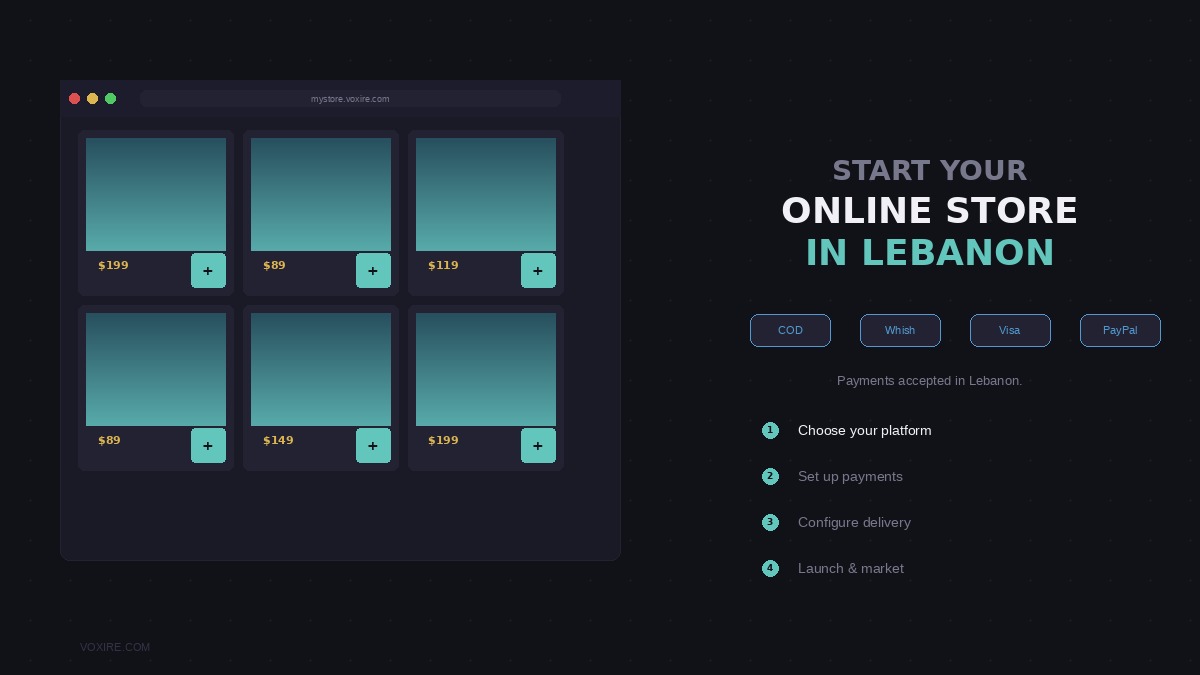
Here is an honest assessment of payment options for Lebanese e-commerce in 2026:
Cash on Delivery (COD). This is still the most used payment method for Lebanese e-commerce orders. Your delivery operation or courier partner collects cash at the door. The downside is a higher return rate and cash flow that depends on collections. Every Lebanese online store needs COD.
Whish Money. Lebanon's leading digital wallet has grown significantly post-banking crisis. Whish integration is available for e-commerce platforms and reaches a broad local user base. If you can integrate one digital wallet, start here.
Credit and debit cards via international gateways. Stripe is available in Lebanon as of 2024 for businesses that can provide the required documentation. PayPal remains available for accepting payments (though Lebanese bank withdrawals have limitations). 2Checkout (now Verifone) and Checkout.com are alternatives that work in the Lebanese market.
Bank transfer and OMT. For higher-value orders, some Lebanese businesses accept bank transfers or OMT payments. This works for a B2B context or luxury goods but adds friction that hurts conversion on typical consumer purchases.
Logistics: getting your product to the customer
For new Lebanese e-commerce businesses, the logistics decision breaks down into three approaches:
Use an established courier with COD service. Companies like Aramex Lebanon, DHL, and local couriers like SMSA and CouriersMe cover most Lebanese governorates. This is the lowest-risk way to start, you pay per shipment and do not need to manage a delivery fleet.
Partner with a logistics startup. Several Lebanon-based tech-enabled logistics companies have emerged offering same-day or next-day delivery in Beirut and surrounding areas with real-time tracking. These typically cost more per delivery but offer a better customer experience for urban orders.
Build your own delivery. For high-volume businesses (50+ orders per day in a concentrated area) or for businesses where delivery is part of the brand experience (premium products, food), an in-house delivery team can be cost-effective. This comes with hiring, management, and operational complexity.
Start with an established courier and only build in-house logistics when volume justifies the investment.
Marketing your Lebanese online store
The Lebanese digital consumer in 2026 is primarily reached through Instagram, TikTok, and Google Search.
Instagram remains the dominant discovery platform for consumer products in Lebanon. Build your product catalog into Instagram Shopping, run well-targeted Meta ads, and invest in authentic product content (photography, video) that performs in-feed and in Stories.
TikTok is growing fast, especially for reaching 18-35-year-old Lebanese consumers. Short product demonstration videos and creator collaborations generate strong traffic.
Google Shopping ads put your products directly in front of people actively searching to buy. For established product categories (electronics, clothing, home goods), Shopping ads often deliver the best return on ad spend.
WhatsApp marketing, building a broadcast list of customers and sending new arrivals, promotions, and order updates via WhatsApp, is uniquely effective in Lebanon compared to email marketing. Lebanese consumers are highly responsive to WhatsApp messages from brands they have bought from before.
Common mistakes Lebanese e-commerce businesses make
Before closing, here are the most expensive mistakes we see Lebanese online stores make:
Launching without a mobile-optimized site. 75%+ of Lebanese e-commerce traffic is mobile. A site that works well on desktop but awkwardly on mobile loses the majority of potential customers at the point of purchase.
Not tracking conversions properly. Without proper Meta Pixel and Google conversion tracking, your ads are running blind. You cannot optimize what you cannot measure.
Ignoring return rate management. COD orders have higher return rates. Build return handling processes from day one, track return reasons, and reduce returns by improving product descriptions and photography.
Underpricing to compete. Lebanese consumers buy on trust and quality as much as price. A cheaper product with poor photography and no reviews often converts worse than a correctly priced product with strong social proof.
The technical foundation of your store, platform choice, checkout flow, payment integrations, and mobile performance, determines whether your launch succeeds or stalls. Voxire's e-commerce development in Lebanon handles the full build so you can focus on your products and marketing.
Ready to launch your Lebanese online store?
Voxire has built e-commerce solutions for Lebanese brands across fashion, food, electronics, and services. We handle everything from store setup and payment integration to SEO and ongoing digital marketing. Talk to us about your store and let us help you build something that actually sells.
Enjoying this article?
Enter your email and get a clean, formatted PDF of this article: free, no spam.
Voxire
E-commerce for the GCC
E-commerce for brands selling into Saudi Arabia, the UAE, Kuwait, and Qatar. Shopify and custom Next.js storefronts, Mada and STC Pay, Tabby and Tamara, Arabic checkout, COD economics, and fulfilment partners that actually deliver.
Learn more