Most Lebanese stores launch in English only. Here is which pages need Arabic first, what the tools cost, and when a full right-to-left build is worth it.
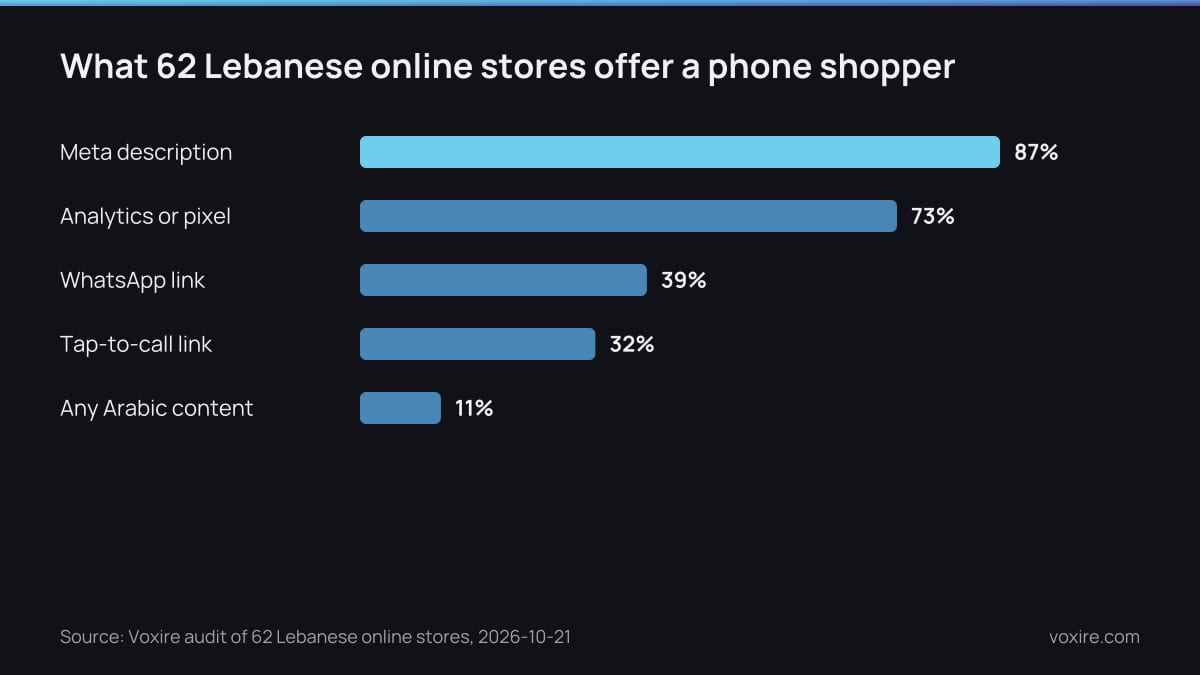
Most Lebanese online stores launch in English only, and few add Arabic later. In our audit of 62 Lebanese online stores, about one in nine carried any Arabic content at all.
That gap is a decision every owner makes when commissioning a store, often without noticing. It is also the question our e-commerce development team hears before most builds: should Arabic be in the first version, or added once sales start? The answer depends on who buys from you and which pages make them hesitate.
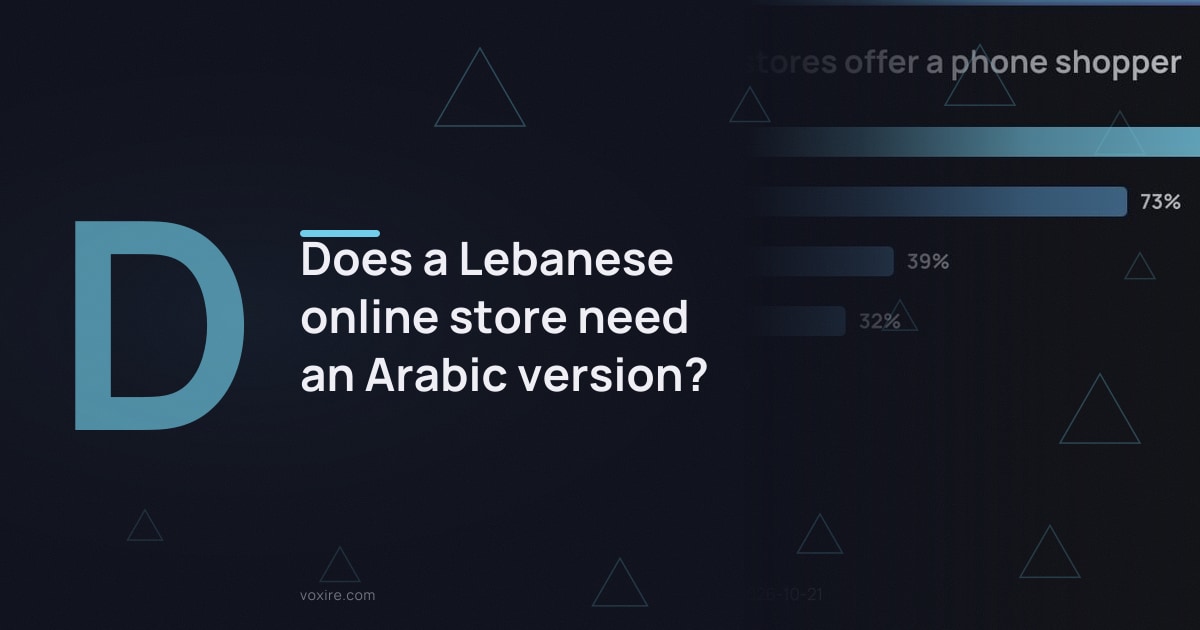
Does a Lebanese online store need an Arabic version?
Not on day one for most stores selling inside Lebanon, but every store needs Arabic where buyers hesitate. A full right-to-left version pays off once you sell to the Gulf, to older shoppers, or to people who search in Arabic script. Plan for it in the first build, even if you switch it on later.
The research everyone quotes supports both sides. CSA Research surveyed 8,709 shoppers in 29 countries and found 76% prefer product information in their own language, while 40% will not buy from sites in another language. The same survey found 67% tolerate mixed languages on one site, and 66% pick the cheaper product even when its information is not in their language.
Lebanon sits near the tolerant end of that survey. Most shoppers here read English, many type Arabic in Latin letters, and a Beirut brand's Instagram captions are usually in English already. The Gulf is different. An Arabic-first buyer in Riyadh or Kuwait compares you with local stores that speak to them in Arabic from the first screen.
That is why we ask one question before we scope any store. Who pays you today, and in which script do they write to you?
How many Lebanese online stores have Arabic today?
Very few: about one in nine of the 62 stores we audited in October had Arabic content or an Arabic hreflang tag. Fewer than four in ten linked WhatsApp from the homepage, which is where many Lebanese buyers ask their first question before ordering.
The web as a whole explains part of the gap. W3Techs finds Arabic on 0.9% of the websites whose language it can identify, against 49.5% for English. Arabic pages are scarce, so a store that has them competes with fewer pages for the same Arabic search.
The stores in our sample were not careless in general. Most had written meta descriptions and installed an analytics tag. Arabic was simply never in the brief. When we take over a store like that, the first thing we check is whether the theme can carry right-to-left layout at all, because that decides whether Arabic is a week of work or a rebuild.
Which parts of the store need Arabic first?
Start with the pages where a buyer decides or worries: the checkout and order emails first, then delivery terms, product names and your WhatsApp replies. A translated homepage with an English checkout loses the Arabic reader at the worst possible moment, right before payment.
In order of how much they cost you when missing:
- Checkout and order emails. Shopify's Help Center says checkout and email notifications switch to the customer's language once you publish it, so this part is cheap on Shopify. Custom platforms need it built.
- Delivery, returns and cash on delivery terms. These are the lines buyers reread before they commit. A native writer should do them, not a machine.
- Product names and search terms. Our post on why shoppers cannot find products found that Shopify's store search does not list Arabic among its supported languages, so Arabic queries need synonyms or a search app.
- WhatsApp quick replies. Most Lebanese orders still pass through a chat at some point. Arabic replies cost nothing to write.
- Size guides and care labels. Short, but they prevent returns.
The catalogue comes last. A store with hundreds of products costs far more to translate well than the ten pages that close the sale. When we scope Arabic in a new store, we price those decision pages separately from the catalogue so the owner can start small.
What does adding Arabic to an online store cost?
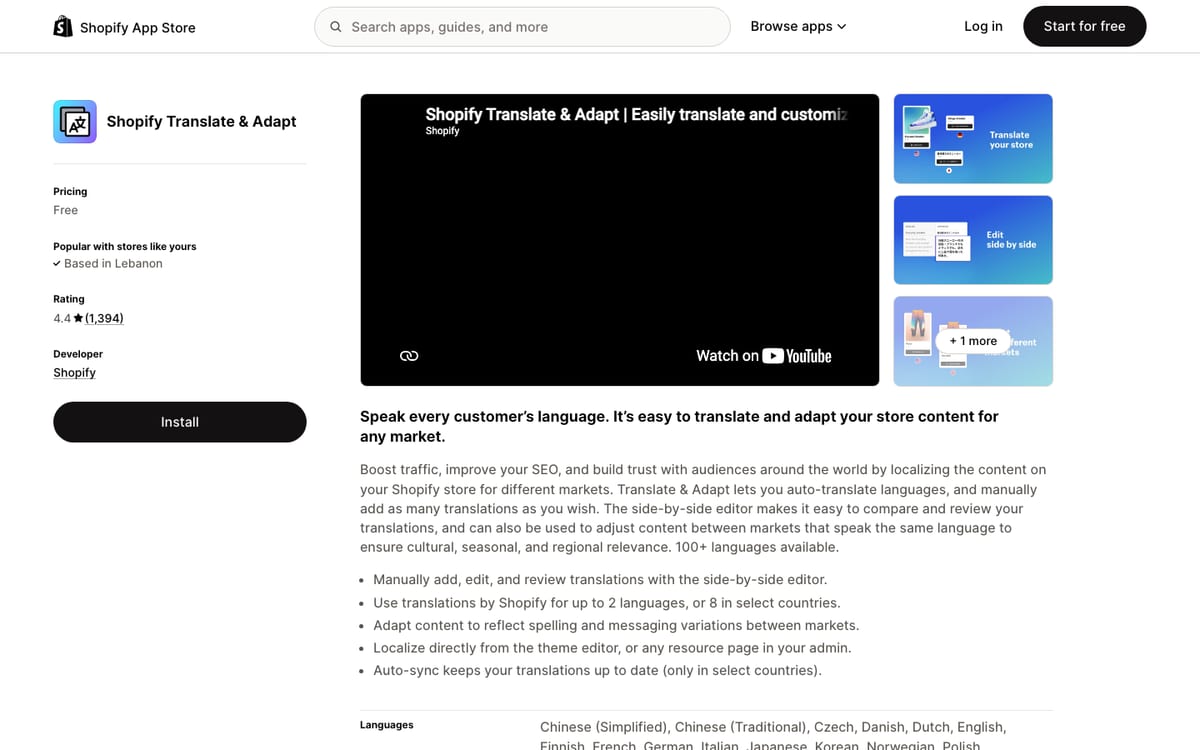
Software costs from nothing to about $32 a month for most small stores; the larger cost is good Arabic copy and right-to-left design. Shopify Translate & Adapt is free with machine translation for two languages, and Weglot's pricing page lists Starter at $17 a month for 10,000 words.
| Route | Software cost | What it covers | Right-to-left layout | Fits |
|---|---|---|---|---|
| English store, Arabic on WhatsApp | $0 | Replies and order confirmations written by hand | Not needed | Stores selling mostly inside Lebanon |
| Shopify Translate & Adapt | Free | Machine translation for two languages, manual editing, a URL per language | Depends on the theme | Shopify stores testing Arabic |
| Weglot Starter | $17 a month | 10,000 words, one translated language | Depends on the site | Small catalogues on any platform |
| Weglot Business | $32 a month | 50,000 words, three translated languages | Depends on the site | Larger catalogues |
| Bilingual build from the start | No translation plugin; priced as part of the build | Every template designed for both directions | Built in | Stores selling to the Gulf or to Arabic-first buyers |
Source: Shopify App Store and Weglot pricing, read 2026-10-27
Want these routes priced for your own store? Get a free quote.
Weglot's word limits count every unique word across all your languages, so a catalogue with long descriptions reaches them quickly. Its pricing page puts the Business plan at $32 a month, or $320 billed yearly, for 50,000 words. Translate & Adapt costs nothing, but you trade money for review time.
Our own number is public. Voxire builds e-commerce stores within our published range of $5,000 to $12,000, and when Arabic is in the brief we design every template for both directions inside that scope. If you only need Arabic on the decision pages, we quote that as a smaller job.
Is machine translation good enough for Arabic product pages?
For a first draft, yes; for anything a buyer acts on, no. Machine translation handles specifications well and trips on sizes, slang, product names and tone. A native reader should check every page a buyer acts on before it goes live, and read it on a phone.
The survey data cuts both ways here too. CSA Research found 65% of shoppers prefer content in their language even when the quality is poor. That is a reason to publish rough Arabic on a product page. It is not a reason to leave your returns policy rough.
Tools also fail in quieter ways. One low review on the Translate & Adapt listing describes custom email templates the app ignored, which left the merchant translating them by hand. After you publish Arabic, place a test order and read every message it sends.
What breaks when Arabic is added after launch?
Layout breaks first: menus, arrows, sliders and form fields must mirror for right-to-left reading, and themes built for English rarely do it cleanly. Text breaks next, when Arabic, English product names and prices display in the wrong order inside one sentence.
Two fixes from our own projects show how small these failures look. A heading animation that revealed text letter by letter split Arabic words into disconnected letters, because Arabic letters change shape when they join. We now animate Arabic by whole words. On the same site, arrow icons that meant next pointed backwards in Arabic until we flipped them under right-to-left.
Direction belongs in the markup. The W3C recommends setting it with the dir attribute on the html element rather than with CSS alone, so browsers and assistive tools read the page correctly. A developer who only flips text alignment has not built Arabic support.
Search needs its own setup. Google Search Central asks for a separate URL for each language with hreflang annotations linking the versions. Shopify handles the URLs when you publish a language; a custom store has to generate them.
Retrofitting is where the bill grows. Before we quote Arabic for an English-only theme, we open every template in right-to-left, because one hard-coded left margin can repeat across hundreds of pages.
What should you actually do this week?
Read your last hundred WhatsApp orders and count how many arrive in Arabic script. Then open your checkout and order emails in Arabic on a phone. If either test shows a gap, fix those pages before you translate a single product.
- Count the Arabic messages. A handful means WhatsApp replies are enough for now.
- On Shopify, publish Arabic with Translate & Adapt on a test theme and place an order.
- Have a native writer redo delivery, returns and cash on delivery terms.
- Ask your developer to show one product page in right-to-left before you buy any app.
- If the Gulf is your next market, budget a bilingual build instead of patches.
If you are still choosing a platform, our guide on whether Shopify works for a store in Lebanon covers plans and payments first.
Sources
- CSA Research: Consumers Prefer their Own Language, read 2026-10-27
- W3Techs: usage of content languages for websites, read 2026-10-27
- Shopify Help Center: languages, read 2026-10-27
- Shopify App Store: Translate & Adapt, read 2026-10-27
- Weglot pricing, read 2026-10-27
- Google Search Central: localized versions of your pages, read 2026-10-27
- W3C: structural markup and right-to-left text in HTML, read 2026-10-27
Want to know which Arabic route fits your store?
Send us your store link and the markets you sell to. We will tell you which pages need Arabic first, whether your theme can carry right-to-left layout, and what a bilingual build costs against a lighter fix from the table above.
→ E-commerce Development → Get a Free Quote → Chat on WhatsApp
Enjoying this article?
Enter your email and get a clean, formatted PDF of this article: free, no spam.
Voxire
Web Development in Lebanon
Production web development for Lebanese businesses. Next.js and React builds, e-commerce, custom applications, bilingual Arabic and English from the first wireframe, USD pricing with fixed scope, and honest numbers on what a build costs here.
Learn more