App builders let a Lebanese owner ship a business app for about $600 a year, until Apple review, payments and Arabic layouts get in the way.
A Beirut shop can publish its own business app this month for under $600 a year. FlutterFlow charges $39 a month for the plan that deploys to the stores, Apple adds $99 a year, and Google Play adds a one-time $25. The harder question is whether that app passes review, takes payments, and still fits the business next year.
That is where most DIY app projects in Lebanon stall. The builders sell speed, and they deliver it. What they leave out is the part after the first demo.
Can I create my own app for business?
Yes, you can create your own business app without writing code, and many Lebanese owners should start that way. Glide turns a spreadsheet into a working app on a $25 monthly plan, and FlutterFlow adds app store publishing at $39 a month. The limits appear later: review rules, payments, and Arabic layouts.
Builders are strongest when the app serves your own team or a small, loyal group of customers. Good fits look like this:
- A stock count or delivery checklist your staff fill in on their phones.
- A staff schedule or shift swap board.
- A loyalty card for regulars at a cafe or gym.
- An event guide for a wedding venue or a conference.
They are weakest when the app touches money, other systems, or the street. Payment flows, a link to your POS, offline use for drivers in areas with weak coverage, and Arabic screens that read correctly right to left all push a builder past what it was designed for. None of that shows up in a ten-minute tutorial.
AI builders have changed the first step, not the rest. A prompt can now produce a decent first screen in minutes. You still have to test it, host it, submit it, and fix it when a customer finds the bug.
Can AI create an app for me for free?
AI can create a first version of your app for free, but free tiers stop before publishing. FlutterFlow's free plan covers up to 2 projects and 10 AI credits, while Glide only allows public apps from its $50 Plus plan. Expect to pay something the day real customers need to open it.
The free tier is still worth using. Build the core screen, show it to five customers, and watch what they tap. If nobody uses it on a free plan, a paid plan will not save it.
How much does it cost to have an app made for my business?
A DIY app costs about $600 in its first year, while our custom MVP builds start at $8,000 before store fees. The DIY figure is FlutterFlow Basic for twelve months plus Apple's $99 yearly fee and Google Play's $25 one-time fee. The custom floor is our published price on the mobile app service page.
| Route | Year-one cost | Runs on | Who owns the code | Main risk |
|---|---|---|---|---|
| Glide Plus, web app | $600 ($50 a month) | Browser and home-screen icon | Glide | No App Store or Play listing |
| FlutterFlow Basic plus both stores | $592 ($468 + $99 + $25) | iOS, Android, web | You, through code download | Apple review and your own testing |
| Custom MVP plus both stores | from $8,124 | iOS and Android | You | Higher upfront cost |
Source: Glide, FlutterFlow, Apple, Google Play, read 2026-10-18
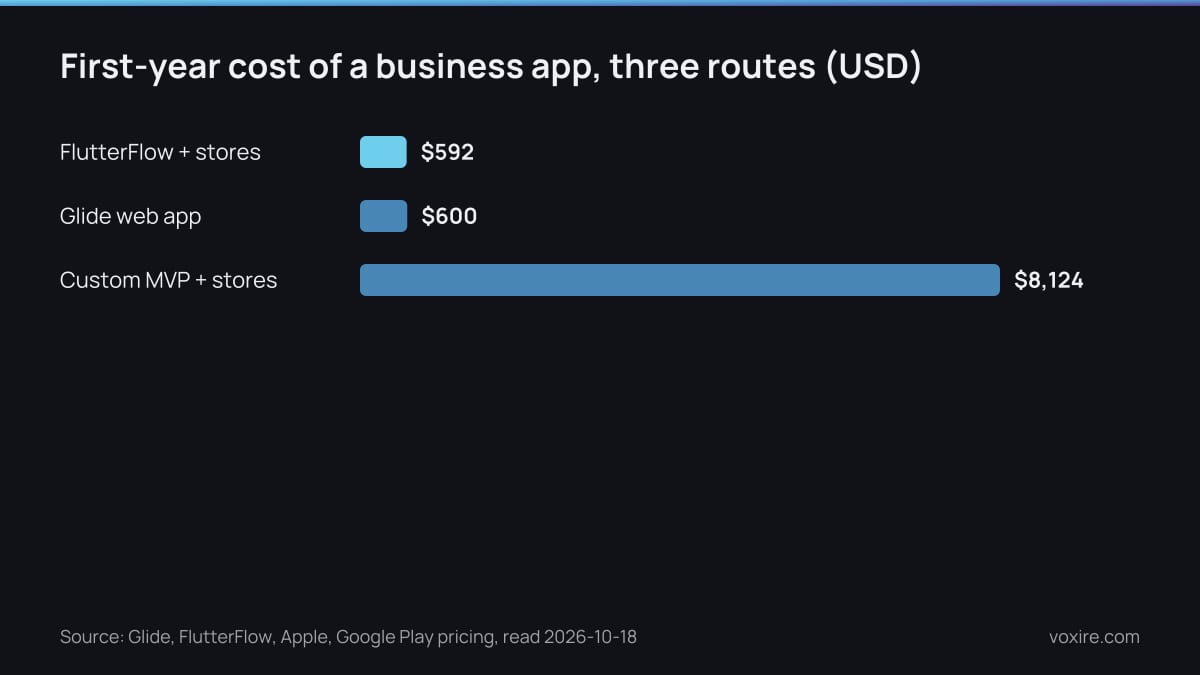
The gap looks huge until you count your own hours. A DIY app is cheap in cash and expensive in attention, because you become the developer, the tester, and the support desk. If you are still deciding whether you need an app at all, our website or app comparison prices both routes for Lebanese businesses.
Will Apple accept an app made with an app builder?
Apple accepts builder-made apps only when the business that owns the content submits them under its own developer account. Guideline 4.2.6 rejects apps made from a commercialized template or app generation service when the service submits for its client. A cloned template with a new logo also risks the spam rule in 4.3.
So the developer account must be yours, not the builder's and not a freelancer's. An organization account lists your legal entity as the seller and asks for a D-U-N-S Number, according to Apple's enrollment page. Our guide to Apple and Google developer accounts from Lebanon walks through that paperwork.
The app also has to do something your website cannot. Apple's guideline 4.2 asks for features and content that lift an app beyond a repackaged website. A menu, an Instagram feed, and a call button will not pass. A booking flow, a loyalty balance, or a stock tool usually will.
How do I start making my own app?
Start with one job the app must do for one group of people, and build only that screen first. Write the job in a sentence, list the data it needs, and test it on a free builder plan before paying. Most owners learn within a week whether the tool fits the job.
The order that wastes the least money:
- Decide who the app serves: your staff or your customers. Internal apps can stay on a web link and skip the stores entirely.
- Build the one screen on a free plan and put it in front of real users.
- Register developer accounts in the company's name, not a personal one.
- Plan your Android test before you plan your launch date.
- Submit to Apple yourself, from your own account.
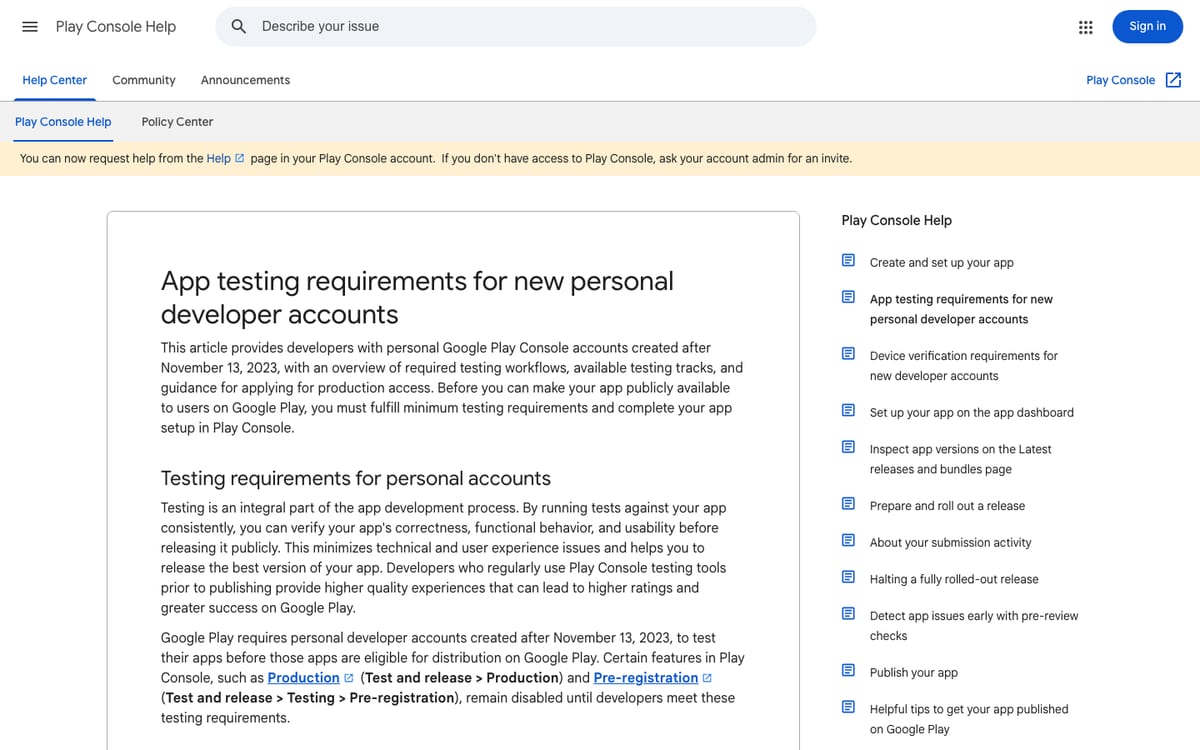
Step four catches many small businesses. Personal Google Play accounts created after November 13, 2023 must run a closed test with at least 12 testers opted in for 14 straight days before production access, according to Play Console Help. A gym with regulars can find twelve testers in a day. A two-person workshop often cannot, which is one more reason to register as an organization.
Can a DIY app take card payments in Lebanon?
A DIY app can take card payments in Lebanon only through a gateway that serves Lebanese businesses, and builder checkouts usually are not one. Built-in payment blocks lean on Stripe, and Stripe's availability list does not include Lebanon. A local gateway such as Areeba needs a custom integration that most builders cannot do.
This is the wall most Lebanese DIY apps hit first. The builder demo shows a smooth card form, and the owner only discovers at setup that the account cannot be opened from Beirut. Some owners route around it with a foreign company, which adds bank, tax, and accounting work that a small shop rarely wants.
Digital subscriptions sold inside an iOS app follow different rules. Apple takes a 15% commission through its Small Business Program for developers under $1 million in yearly proceeds. That route works for a fitness class pass, not for a dress shipped to Jounieh.
When we build for Lebanese clients, the checkout is usually the first custom piece. We wire it to what customers here actually use: cash on delivery, Whish or OMT transfers, and cards through a local acquirer.
When should a Lebanese business stop building it alone?
Stop building alone when the app must move money, sync with a POS or ERP, or serve Arabic readers who expect a proper right-to-left layout. Those three jobs need code you control. The builder version still has value as a prototype that proves customers want the app.
Other signals that the builder has reached its ceiling:
- Monthly fees climb with seats and credits; Glide's Pro plan starts at $125 a month.
- Drivers or field staff need the app to work offline.
- You want customer data in your own database, not the vendor's.
- Apple has rejected the build and the fix sits outside the builder.
That handover is where Voxire usually comes in. We treat the prototype as a living spec, keep the screens customers used, and rebuild in React Native or native code with Arabic RTL and local payments. Our MVP cost breakdown shows what our own published $8,000 MVP price covers, as listed on the mobile app service page. The app timeline guide shows how long each stage takes.
What should you actually do this week?
Prove demand before you build a single extra feature. Pick the single task your customers or staff repeat most, build it on a free plan, and put it in front of five real users. How they behave tells you whether to keep going alone or brief a developer with a working prototype in hand.
- Write the app's one job in a single sentence and share it with your team.
- Request a D-U-N-S Number for the company now, before Apple asks for it.
- Ask your bank or payment provider which online payment methods it supports for an app.
Sources
- Apple App Review Guidelines, read 2026-10-18
- Apple Developer Program enrollment, read 2026-10-18
- App Store Small Business Program, read 2026-10-18
- Play Console Help: closed testing rules for personal accounts, read 2026-10-18
- Google Play: register for a developer account, read 2026-10-18
- Stripe global availability, read 2026-10-18
- Glide pricing, read 2026-10-18
- FlutterFlow pricing, read 2026-10-18
Want a second opinion before you build it yourself?
Send us your builder prototype or a one-page description of the app. We will tell you which parts a builder can carry, which need custom code, and what that custom part costs against our published prices.
→ Mobile App Development → Get a Free Quote → Chat on WhatsApp
Enjoying this article?
Enter your email and get a clean, formatted PDF of this article: free, no spam.
Voxire
Mobile App Development
React Native and native iOS and Android for MENA. RTL support done properly, regional payment integration, App Store and Play Store submission, and the architecture decisions that keep a small app maintainable.
Learn more