The build takes 8 to 14 weeks, but the store stage is where Lebanese launch dates slip, and it can be planned to the day.
Most Lebanese app projects that miss their launch date lose the time after the code is finished, not before it. A well scoped MVP takes 8 to 14 weeks to build, as we publish on our mobile app development page. Google Play then adds at least 14 days for any new personal developer account, because it requires a closed test with 12 testers before production (Google Play Console Help). Plan for both clocks from week one.
How long does it take to build an app?
A focused app takes 8 to 14 weeks to build, and a full consumer or enterprise app takes 4 to 6 months, before store approval is counted. Those are the ranges on our mobile app development page, and they assume a written scope at kickoff. The store stage then adds anywhere from two days to three weeks.
The low end fits one user journey. A customer orders, books or pays, and an admin screen manages it. The high end fits two user roles, a payment gateway such as Areeba or Tap, and Arabic and English layouts designed together. Every extra role adds design screens, backend rules and test cases, so scope decides the calendar more than team size does.
Other Lebanese agencies quote similar ranges. Step to Media puts the build phase alone at 6 to 14 weeks and adds a store review buffer of 1 to 3 weeks, with no source for the buffer. The buffer is the part that can actually be measured, so most of this post measures it.
Which phase of an app build takes the longest?
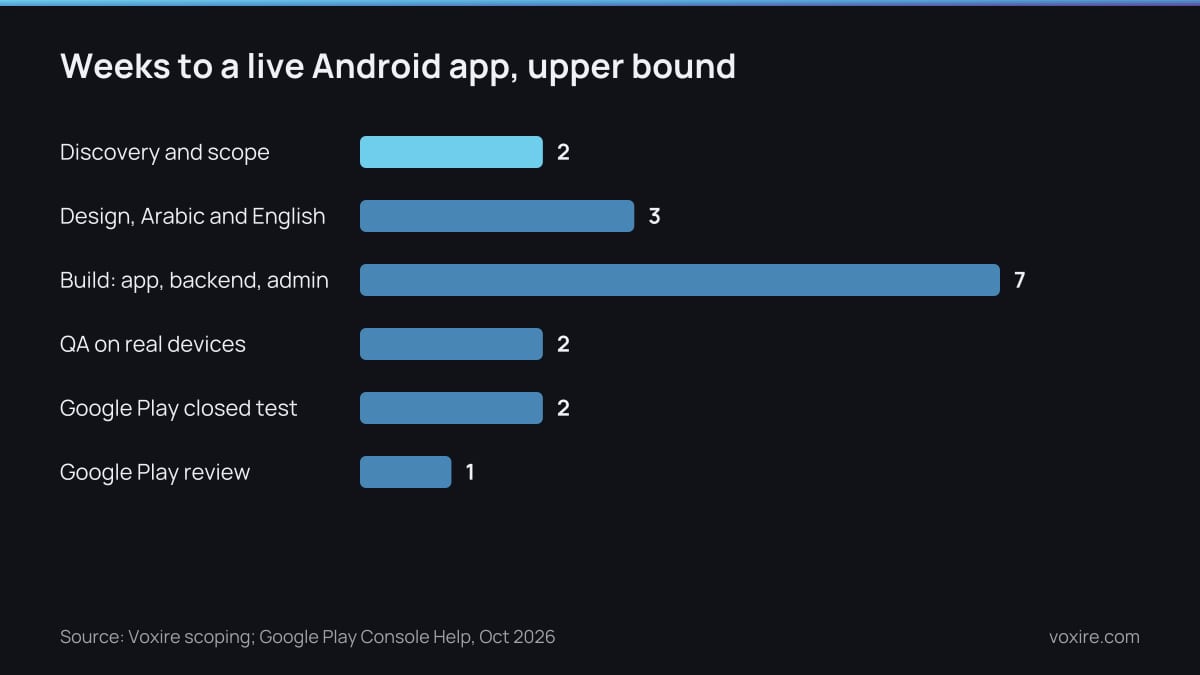
The build phase takes the longest, at 4 to 7 of the 8 to 14 weeks, because the app, the backend and the admin dashboard are written in parallel. On our mobile projects discovery takes 1 to 2 weeks, design 2 to 3, and real device QA 1 to 2. Integrations decide where in the build range you land.
The table below adds the store stages that most timelines leave out. It is the plan we hand a client at the end of discovery.
| Stage | Typical length | What stretches it |
|---|---|---|
| Discovery and written scope | 1 to 2 weeks | Features added after sign off |
| UX and UI design, Arabic and English | 2 to 3 weeks | Arabic screens designed after the English ones |
| Build: app, backend, admin | 4 to 7 weeks | Payment, SMS and WhatsApp integrations |
| QA on real Android and iPhone devices | 1 to 2 weeks | Late content and store screenshots |
| Google Play closed test, new personal account | 14 days minimum | Testers who opt out before day 14 |
| Google Play review | Up to 7 days, longer in exceptional cases | Extended review of the app |
| Apple App Review | 90% within 48 hours | A rejection that restarts the queue |
| D-U-N-S number for an Apple company account | Up to 5 business days, plus 2 for Apple | A D&B profile that needs updating |
Source: Voxire, Google Play testing, Google Play review, read 2026-10-16.
Source: Apple App Review, Apple D-U-N-S, read 2026-10-16.
Late content is the delay we see most often. Screenshots, legal copy and the privacy policy are owned by the client, and they are needed before upload, not after.
Why does Google Play hold new apps for 14 days?
Google Play holds apps from new personal accounts for at least 14 days because it requires a closed test with 12 testers opted in continuously before production. The rule covers personal accounts created after 13 November 2023, according to Google Play Console Help. After that you apply for production access and wait for review.
Testers who leave early do not count. If a tester opts out and later returns, their 14 days must run consecutively again, per the same Google page. Twelve is a floor, so recruit twenty: staff, family and a few loyal customers. Each one needs a Google account and must stay enrolled.
Review after that is usually quick. Google states that some apps get extended reviews of up to 7 days, or longer in exceptional cases (Google Play Console Help).
Here is the move most teams miss. Start the closed test during the last sprints of the build, not after QA. The test only needs an installable build, and every fix you push during those two weeks reaches the same enrolled testers. Run this way, the test costs nothing on the calendar.
What gets an app rejected by Apple?
Apple turns an app back when it breaks the App Review Guidelines, and the avoidable cases we handle are blocked logins, broken privacy links and unsupported payment flows. Clean submissions move fast: Apple reviews at least 50% in under 24 hours and 90% in under 48 hours, per its App Review page.
A rejection sends you back into the queue after the fix. The real risk is a second or third round, not the first wait. Give the reviewer a working demo account in the review notes. Route any digital purchase through in app purchase where Apple expects it. Then open the privacy link from a phone on mobile data.
Why does an Apple company account add a week?
An Apple company account adds about a week because Apple verifies the business through a D-U-N-S number before enrollment. Dun & Bradstreet can take up to 5 business days to issue one, and Apple then needs up to 2 more business days to receive it, per Apple's D-U-N-S page. Expediting does not shorten the wait.
The fees are small next to that wait. Apple charges 99 USD a year (Apple enrollment support), and Google charges a one time US$25 registration fee (Google Play Console Help). Our guide to opening Apple and Google developer accounts from Lebanon covers the card and verification steps.
We open both stores in the client's company name during discovery. The client owns the listings from the start. Google's closed test rule is also written for personal accounts, so an organisation account avoids it.
Should a Lebanese business launch on Android or iPhone first?
Launch on both when the budget allows; if you must pick, start with Android, which holds 72.9% of Lebanon's mobile market share per StatCounter for September 2026. That puts Google's closed test on your critical path. iPhone holds the other 27.1%, so skipping it still leaves out a quarter of your market.
We build most Lebanese client apps in React Native, so both stores get the same release from one codebase. The order of submission still matters. Submit to Apple and start the Google closed test in the same week.
Marketplace products need extra care. A food delivery app can need separate listings for customers and riders. On a personal account, each new listing runs its own closed test.
How much does it cost to have a mobile app developed?
A focused mobile app MVP starts from $8,000 at Voxire, and a full app starts from $15,000. Both are fixed prices set after scoping, as listed on our mobile app development page. Time and price move together, because every week removed from the scope is removed from the invoice too.
For a market comparison, our breakdown of mobile app costs in Dubai shows how the same scope prices where budgets are larger.
What should you actually do this week?
Open the developer accounts this week, in your company's name, because the D-U-N-S wait runs alongside design and costs nothing to start early. Then write down the one user journey your first version must handle. Recruit twenty testers with Google accounts before the build reaches its final sprint, so the closed test never blocks launch.
- Request a D-U-N-S number and start Apple enrollment as an organisation.
- Register the Google Play account in the company name.
- Write a one page scope: users, the main journey, payments and languages.
- Prepare a privacy policy URL and a demo login for reviewers.
- Put the closed test start date inside the project plan.
Do these five things and the store stage stops being a guess.
Sources
- Apple Developer: App Review, read 2026-10-16
- Google Play Console Help: app testing requirements for new personal developer accounts, read 2026-10-16
- Google Play Console Help: prepare your app for review, read 2026-10-16
- Apple Developer: D-U-N-S Number, read 2026-10-16
- Apple Developer: enrollment support, read 2026-10-16
- Google Play Console Help: registration fee, read 2026-10-16
- StatCounter: mobile operating system market share in Lebanon, read 2026-10-16
- Step to Media: mobile app development timeline in Lebanon, read 2026-10-16
Ready to put a real launch date on your app?
Send us the one journey your app must handle and the market you launch in. We will return a fixed scope and a week by week plan with the store stages already inside it, plus a price.
→ Mobile App Development → Get a Free Quote → Chat on WhatsApp
Enjoying this article?
Enter your email and get a clean, formatted PDF of this article: free, no spam.
Voxire
Mobile App Development
React Native and native iOS and Android for MENA. RTL support done properly, regional payment integration, App Store and Play Store submission, and the architecture decisions that keep a small app maintainable.
Learn more