What it costs each year to keep a mobile app live in Lebanon: store fees, the 2026 Apple and Google deadlines, Android testing, hosting and SMS.
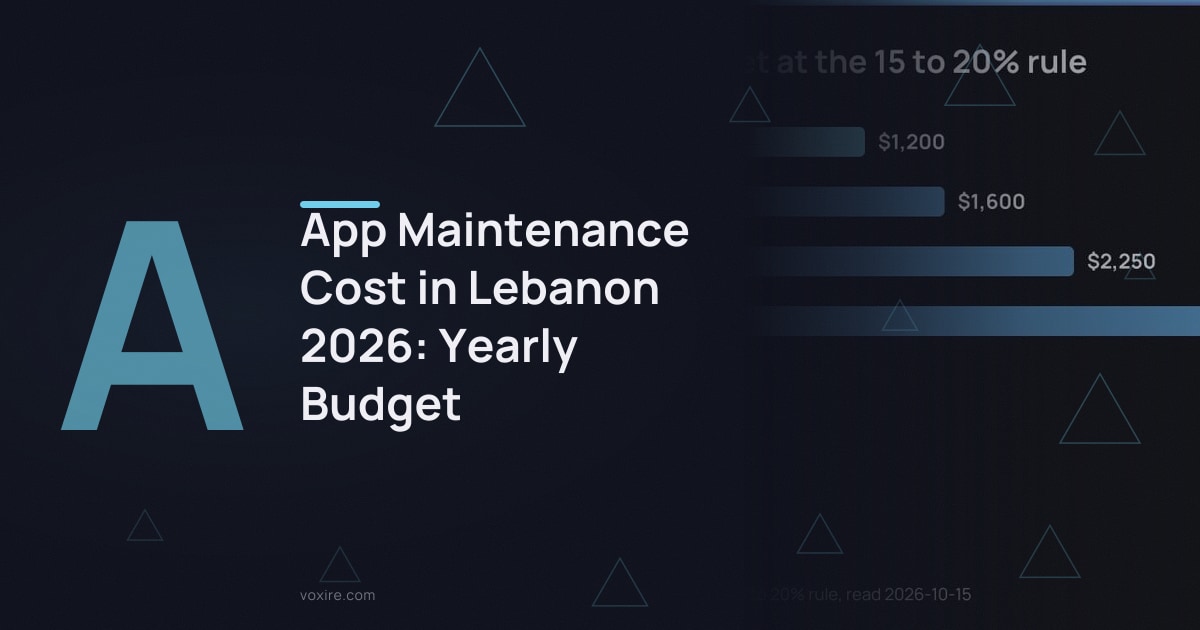
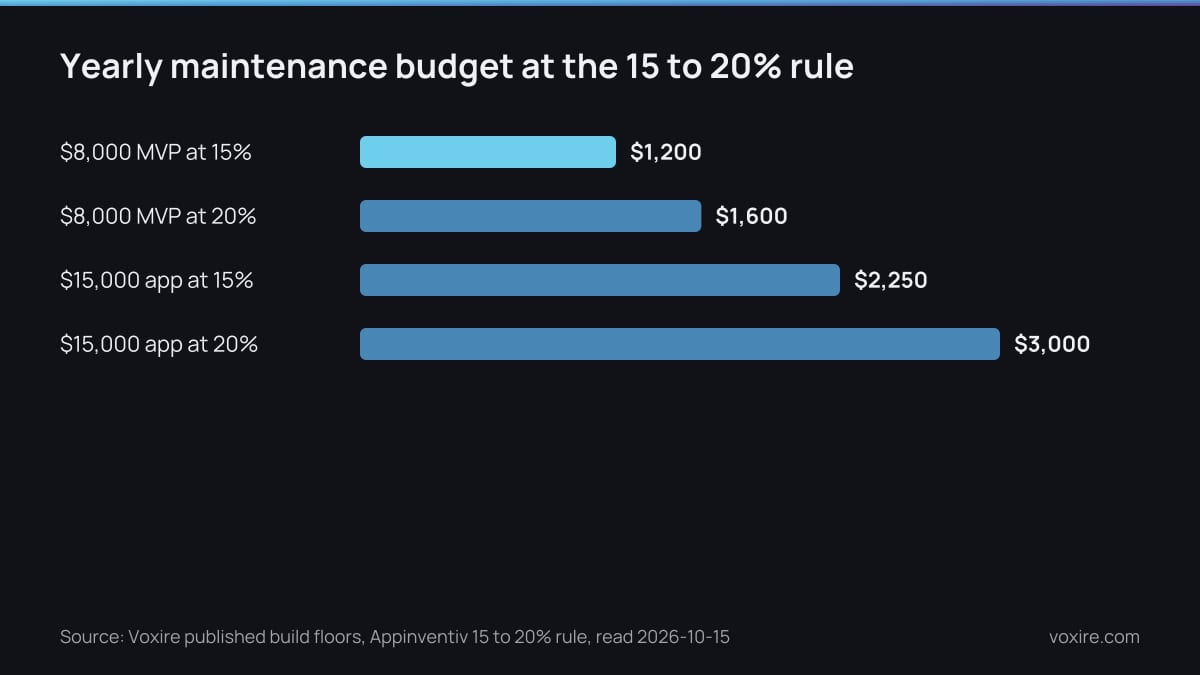
An $8,000 app costs about $1,200 to $1,600 a year to keep on the stores, and most Lebanese owners find that out after launch. That range applies the 15 to 20% yearly rule to the $8,000 MVP floor Voxire publishes. The rule is a fair start. It misses what actually sets your bill in 2026: two dated deadlines from Apple and Google, and the Android phones your customers carry.
The sections below cover the fixed bills, the update work, the Lebanese cost lines that global guides skip, and what a support contract should list before you sign it. Every figure links to the page it came from.
How much does it cost to run an app?
The fixed bills to run a small business app start at $99 a year for Apple and a one-time $25 for Google Play. Apple charges its developer fee every membership year, and Google Play charges once. Push notifications and crash reports on Firebase cost nothing at small scale. The rest of the yearly budget is developer time.
Hosting is the line that grows. Firebase's no-cost Spark plan includes 50K document reads and 20K writes a day on Cloud Firestore, with 1 GiB stored, according to its pricing page. A loyalty or ordering app for one Lebanese shop rarely crosses those limits in its first year. A delivery app with live driver tracking will, and from then on the database bill rises with every order.
One Lebanese line catches owners out. If customers log in with a code sent by text message, Firebase bills Phone Auth per SMS sent, and the cost of each message depends on the destination country. On client apps we default to email login and keep SMS codes for payments or account recovery, where the extra cost buys real security.
| Cost line | Year one | Each later year | Who sets the price |
|---|---|---|---|
| Apple Developer Program | $99 | $99 | Apple |
| Google Play registration | $25 | $0 | |
| Push notifications (FCM) | $0 | $0 | Firebase |
| Crash reports (Crashlytics) | $0 | $0 | Firebase |
| SMS login codes | Billed per SMS | Billed per SMS | Firebase |
| Update work, 15 to 20% of an $8,000 build | $1,200 to $1,600 | $1,200 to $1,600 | Your developer |
Source: Apple enrollment, Google Play Console Help, Firebase pricing, Appinventiv, Voxire mobile app development, read 2026-10-15
How much money does it take to keep an app running?
Budget $1,200 to $3,000 a year to keep a Voxire-sized app current, covering the developer hours that store updates need. That is the 15 to 20% rule applied to the floors on our mobile app development page: $8,000 for an MVP and $15,000 for a full app. Store fees sit on top, and bigger apps scale the same way.
Where does that money go? From the apps we support after launch, it splits four ways. There is one planned update for each store deadline, and security patches for the libraries the app depends on. Then come crash fixes found on real devices, and small changes the owner asks for. That last item is the one to cap.
A contract that lets new features ride in under the word maintenance is how a modest yearly line doubles without anyone noticing. We quote any new screen or integration as its own fixed price, so the upkeep number stays the upkeep number.
Is the 15 to 20 percent rule right for a small Lebanese app?
It is a sound floor for a small app, but no study stands behind it, and the deadlines matter more than the percentage. Appinventiv states 15 to 20% a year, and Google's AI Overview repeats a 15 to 25% band, citing agency blogs rather than research. Treat it as a planning number, then check it against your app's real update calendar.
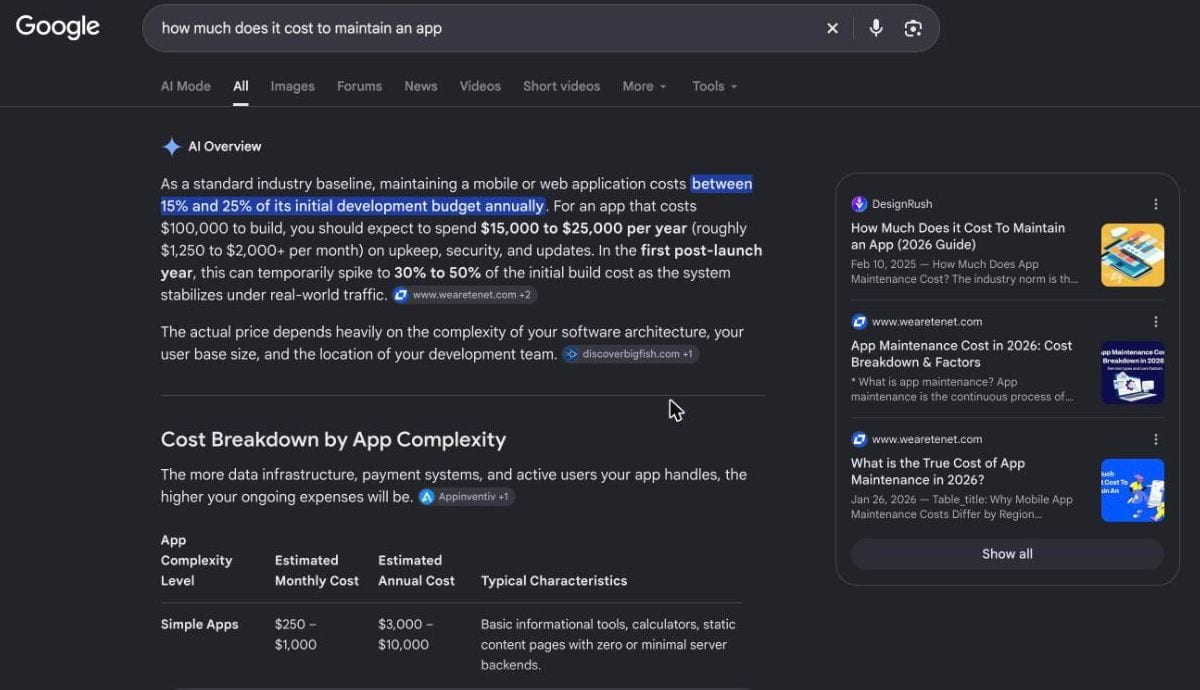
The rule also strains at the small end. The same Appinventiv guide says first-year maintenance can reach 50% of the build cost, and its cost tiers are written for enterprise budgets. Applied to an $8,000 MVP, that would mean $4,000 in year one, which is more than a focused app with a handful of screens needs. Small apps cost less to keep alive because there is less code to update.
At Voxire we price support from the app itself, not from a percentage. We look at how many screens it has, which third-party SDKs it carries, and whether it takes payments. A payment SDK update is the one change we never postpone, because a broken checkout costs more in a day than a year of patches.
Which Apple and Google deadlines force an update in 2026?
Two dated rules force paid work this year: Apple's Xcode 26 requirement and Google Play's API level 36 requirement. Since April 28, 2026, Apple only accepts uploads built with Xcode 26 and the iOS 26 SDK. From August 31, 2026, Google Play requires new apps and updates to target Android 16, which is API level 36.
Missing Google's date carries a quiet penalty. Existing apps must target API level 35 or higher to stay available to new users on newer phones, so an older app simply stops appearing for them. Google lets developers request an extension to November 1, 2026. Apple's rule is blunter: an app built on an older Xcode cannot upload any new build, so even a one-line bug fix waits for the upgrade.
Each deadline usually means updating the framework, its plugins and the payment SDK together. On a React Native app like the ones we build, that is a few days of engineering plus a full round of device testing. The framework you chose at the start shapes this work, which our comparison of Flutter and React Native for Lebanese startups covers. We schedule the update in the month a store announces its rule, not the week before it lands.
Why does Android testing drive the bill in Lebanon?
Android runs on 72.9% of mobile devices in Lebanon, so most of your testing budget belongs on Android phones. That is Statcounter's figure for September 2026, against 27.1% for iOS. Those Android phones span many makers, screen sizes and system versions, and every store update has to be checked across them before it ships.
Several global guides already note that Android upkeep runs higher. In Lebanon the gap is wider. We test every release on real mid-range Android devices of the kind most Lebanese customers carry, plus a current iPhone. We also run the app on throttled connections, because mobile data here drops often and a slow screen reads as a broken one.
Arabic layouts get their own pass. A library update can quietly break right-to-left screens, date formats or Arabic fonts, and nobody notices until a customer sends a screenshot. Catching that before release is cheaper than a one-star review.
What should an app maintenance contract in Lebanon include?
A good contract names the response time, the store deadlines it covers, the devices it tests on, and who owns the store accounts. Anything outside that list, including new features, should be quoted separately before work starts. That split keeps a yearly maintenance budget predictable, and it is how Voxire writes its own post-launch support scope for every mobile client.
Check for these lines before you sign:
- Store deadline updates. Each Apple and Google SDK rule for the year, built and tested, with a named month for each.
- Security and dependency patches. Libraries updated when a fix is published, not saved for a big release.
- Crash monitoring. Someone reads the crash reports every week and tells you what they found.
- Device list. The Android and iPhone models the release is tested on, written down.
- Account ownership. Apple and Google accounts in your company's name, with the renewal on a company card. Our guide to Apple and Google developer accounts from Lebanon explains why.
- Exit terms. Source code, store access and hosting handed over if you change developer. See what to check before you sign with app developers.
Our own scope follows that list. After launch we keep watching crash reports, ship the store-deadline updates, and quote any new feature as its own line. Most of our mobile clients stay on a monthly support retainer, as the mobile app development page says, and the scope is agreed in writing before launch.
What should you actually do this week?
Find out which Xcode version and Android API level your app was last built against. If the Android target is below API level 35, the app is already hidden from new users on newer phones under Google's rule. Then put three figures on paper: the store fees, the hosting bill, and the hours your developer needs per deadline.
- Ask your developer for the last build date and the target API level, in writing.
- Check that the 99 USD Apple renewal sits on a company card, not a freelancer's.
- Open the Firebase console and compare last month's usage with the no-cost limits.
- Count how many customers log in with an SMS code.
- Get one fixed quote for this year's deadline work before the extension window closes.
If you are still budgeting the build itself, read what a mobile app costs in Lebanon first. Then add the yearly line from this page to the plan.
Sources
- Apple Developer: Upcoming requirements, read 2026-10-15
- Apple Developer: Enrollment support and program fee, read 2026-10-15
- Google Play Console Help: Get started with Play Console, read 2026-10-15
- Android Developers: Meet Google Play's target API level requirement, read 2026-10-15
- Statcounter: Mobile operating system market share in Lebanon, read 2026-10-15
- Firebase pricing, read 2026-10-15
- Appinventiv: Mobile app maintenance costs 2026, read 2026-10-15
Want a fixed yearly number for your app's upkeep?
Send us your app's store links and we will tell you which 2026 deadlines it still owes, what the update work costs, and whether the hosting bill is about to grow. If we build your app, the support scope is in writing before launch.
→ Mobile App Development → Get a Free Quote → Chat on WhatsApp
Enjoying this article?
Enter your email and get a clean, formatted PDF of this article: free, no spam.
Voxire
Mobile App Development
React Native and native iOS and Android for MENA. RTL support done properly, regional payment integration, App Store and Play Store submission, and the architecture decisions that keep a small app maintainable.
Learn more