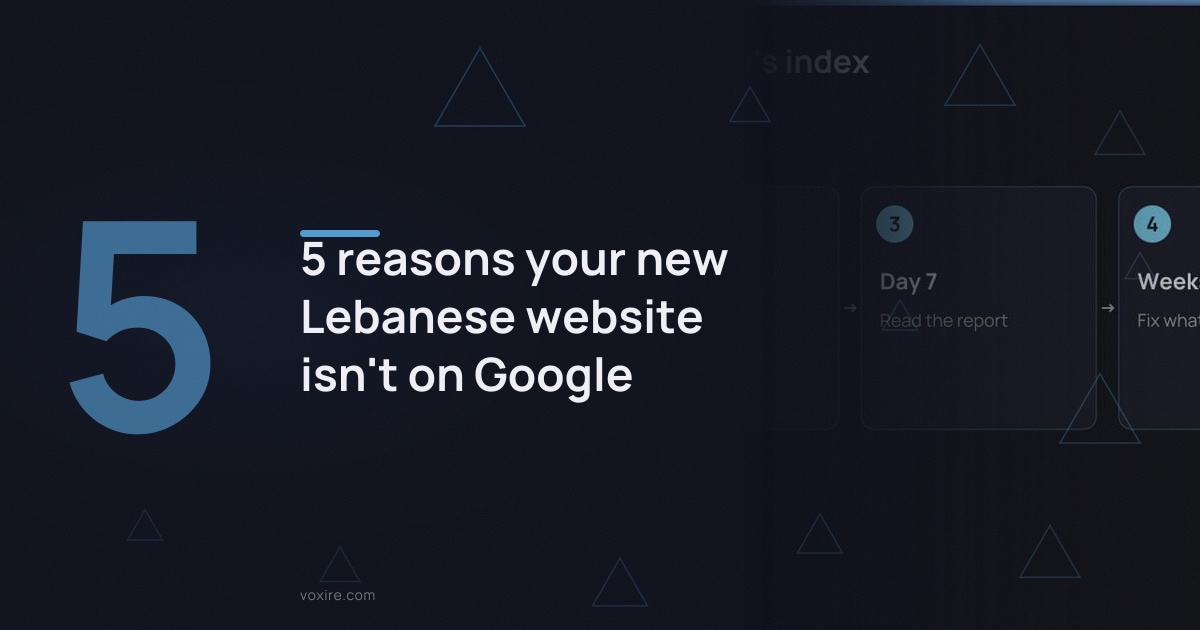
Why a newly launched Lebanese website still does not appear on Google, the five causes we check in order, and what each one takes to fix.
Google tells site owners to allow at least a week after submitting a sitemap before assuming anything is wrong. Past that week, a new site that still does not appear for its own name usually has one of five problems. All five show up in Google Search Console, which is free. It matters more here than almost anywhere: StatCounter puts Google at 94.83% of searches from Lebanon in October 2026.
Two of them came up in builds we shipped this year. One was a restaurant site that needed its robots file and sitemap in place. The other was a property platform where a missing page showed an error panel instead of a proper not-found. This post walks through the five in the order we check them when a client asks why Google cannot find them.
Why isn't my new website showing on Google?
A new website missing from Google usually has one of five problems. It is too new, it tells Google to stay away, Google cannot find its pages, its pages return the wrong status code, or Google indexed a different version of the domain. Search Console confirms each one.
| Reason | How to check | Who fixes it |
|---|---|---|
| Too new | Search site:yourdomain.com on Google | Nobody: wait, then check again. |
| Blocked | URL Inspection in Search Console | Developer: remove the noindex rule or robots.txt block. |
| Not discovered | Sitemaps report in Search Console | Developer: publish and submit a sitemap. |
| Wrong status code | Page indexing report, soft 404 and 5xx rows | Developer: return 404 for missing pages, fix server errors. |
| Wrong version | URL Inspection, Google-selected canonical | Developer: redirect every variant to one domain. |
Source: Search Console Help, Google status codes, read 2026-11-12.
How long does it take for a website to show up on Google?
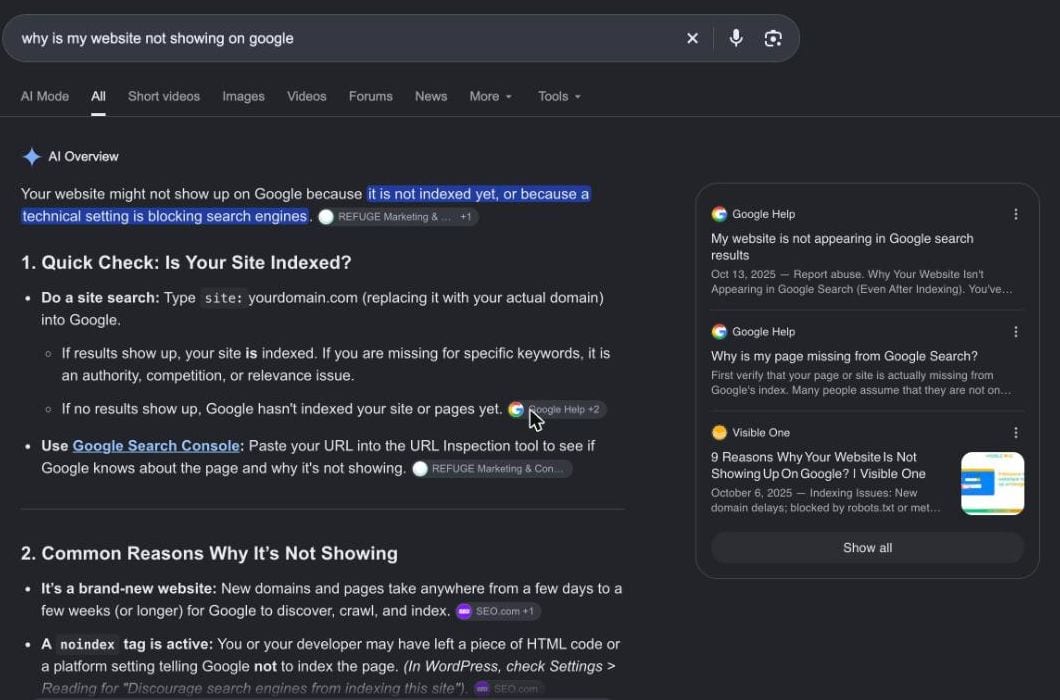
A new page takes anywhere from a day or two to a few weeks to appear, according to Google's help page on missing pages. Google asks owners to allow at least a week after submitting a sitemap before treating a missing page as a real problem.
The clock starts when Google first hears about the site, not when it goes live. A domain nobody links to and no sitemap points at can sit unseen for much longer. That is why the first job on launch day is telling Google the site exists. Once a page is in the index, ranking is a separate question, which our guide to ranking on Google in Lebanon covers.
Is the site telling Google to stay away?
The most common cause on a fresh launch is a setting left over from development that tells search engines to keep out. It is either a noindex rule on the pages or a robots.txt file that blocks crawling. Both take a developer minutes to remove once someone notices.
Sites are usually built on a staging address with indexing switched off, which is correct until launch day. Then the switch has to be flipped back, and it often is not. Paste any page into URL Inspection and Search Console will say whether a noindex rule or a robots.txt block is stopping it. When the goal really is to keep a page out of results, Google's robots.txt guide points you to noindex instead.
Does Google know your pages exist?
Google finds pages through links and sitemaps, so a site with neither can stay invisible for weeks. Publish a sitemap listing every page you want found, submit it once in Search Console, and make sure every page can be reached by ordinary links from the home page.
A sitemap is a plain file listing your page addresses. One file can hold up to 50,000 URLs, Google says, far more than a firm or restaurant site needs. Most site builders generate one for you. Custom builds often do not, which is why the robots file and sitemap are a line item in our restaurant builds, as our local SEO guide for restaurants explains. Menus that appear only after a tap, or links inside images, are weak signals too.
Do missing pages return a real 404?
A page that does not exist should answer with a 404 status code, not a friendly error screen that tells Google everything is fine. Search Console flags pages that look empty or broken while reporting success as soft 404 errors, and they quietly waste Google's attention.
This one is invisible to visitors, which is why it survives launch. On a property platform we build, a removed page showed an error panel while telling Google it had loaded fine. The fix turned a missing page into a proper not-found. Server errors do the opposite damage: Google's status code guide says 5xx responses make its crawlers slow down, so a flaky host can keep a new site waiting.
Has Google picked the wrong version of your domain?
Google may index a version of your site you did not intend, such as the old http address, the www or bare domain, or a leftover staging copy. URL Inspection shows the Google-selected canonical for any indexed page, and a permanent redirect to one version settles it.
This shows up most after a redesign or a move from an older site. Google's canonical guide covers the ways to tell it which version you prefer. Type each variant of your address into a browser and confirm it lands on the same one. Our checks before paying a web company include this test at handover.
How can I force Google to crawl my website?
You cannot force it, but you can ask: paste the page into URL Inspection in Search Console and click Request Indexing. Google's recrawl guide warns there is a quota on these requests, so use them for key pages and let the sitemap cover the rest.
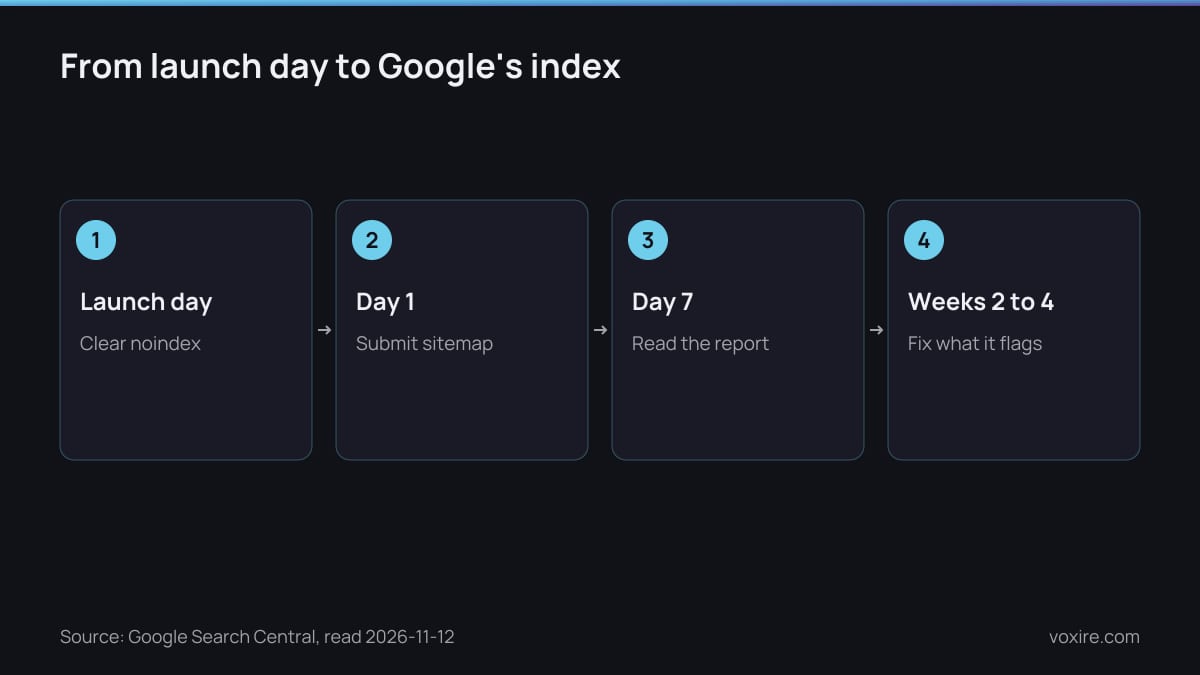
The same guide says crawling can take anywhere from a few days to a few weeks after a request. On launches we run, we request indexing for the home page and the main service pages on day one, submit the sitemap, and read the Page indexing report a week later. Bing, with 3.89% of Lebanese searches by the same StatCounter count, takes instant notices through IndexNow, which we ping on every publish. If you would rather hand this off, our SEO service in Lebanon covers it from the first month.
What should you actually do this week?
Open Google Search Console today, verify your domain and submit your sitemap, then come back in a week. If the site is still missing after that, work through the five checks above in order. Each one takes minutes to confirm, and only the fixes need a developer.
- Search site:yourdomain.com and note what appears.
- Paste the home page into URL Inspection.
- Submit the sitemap in the Sitemaps report.
- Type a made-up address on your site and confirm it shows a not-found page.
- Type the http and www versions and confirm each redirects to one address.
Sources
- Search Console Help: why a page can be missing from Google, read 2026-11-12
- Search Console Help: what the URL Inspection tool reports, read 2026-11-12
- Google Search Central: how status codes and errors affect crawling, read 2026-11-12
- Google Search Central: keeping a page out with noindex, read 2026-11-12
- Google Search Central: what robots.txt does and does not do, read 2026-11-12
- Google Search Central: what a sitemap is for, read 2026-11-12
- Google Search Central: sitemap size limits and submission, read 2026-11-12
- Google Search Central: requesting a recrawl and its quota, read 2026-11-12
- Google Search Central: how Google chooses a canonical address, read 2026-11-12
- StatCounter Global Stats: search engines used in Lebanon, October 2026, read 2026-11-12
- IndexNow protocol home page, read 2026-11-12
Need a second pair of eyes on why Google cannot find your site?
We run these five checks as the first step of every SEO engagement, and most take an afternoon to confirm. Send us the address and the date it went live, and we will scope what fixing it takes.
Enjoying this article?
Enter your email and get a clean, formatted PDF of this article: free, no spam.
Voxire
SEO in Lebanon
Technical SEO, local search, and bilingual Arabic-English content for Lebanese businesses. Audits, keyword research, on-page work, and the link building that actually moves rankings in a market where most competitors have never run one.
Learn more