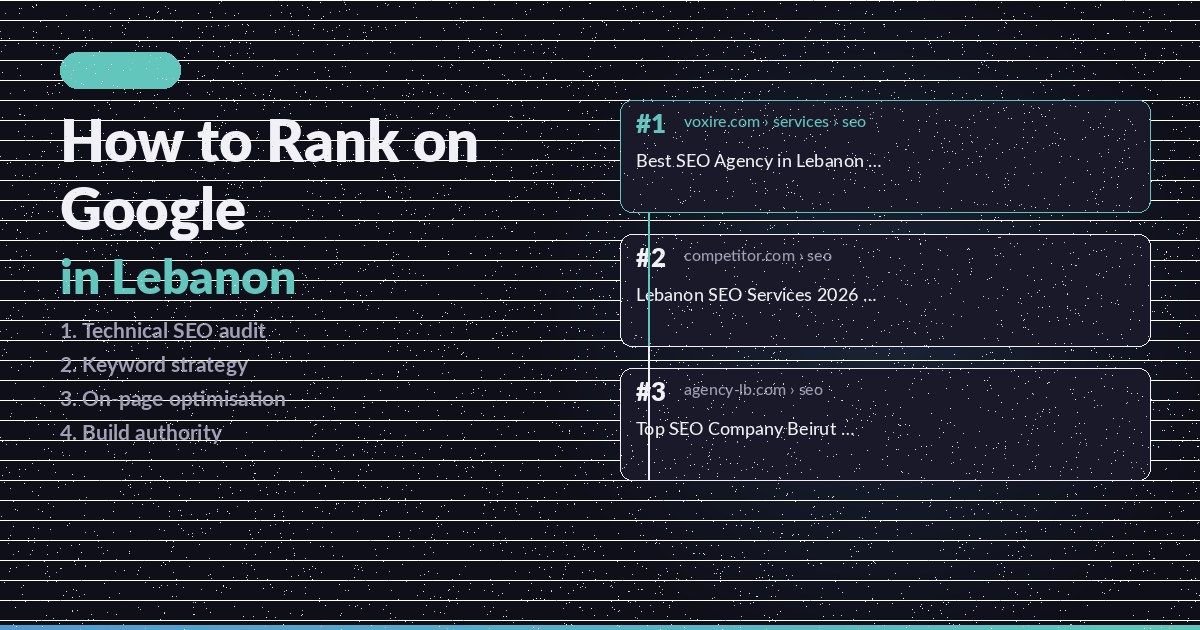
Ranking on Google in Lebanon is more achievable than most Lebanese business owners think. The competition is weaker than in the UK or UAE, and most local websites have fundamental technical problems that are easy to fix. This is the complete guide: no fluff, no generic advice.
The short answer
Ranking on Google in Lebanon requires four things working together: a technically healthy website, content that answers what Lebanese users are searching for, backlinks from credible websites, and a properly optimized Google Business Profile. Most Lebanese businesses are missing at least two of these. Fix all four and you will rank: often faster than you expect, because your competition is not doing this either. See also: E-commerce SEO for Arabic-Language Stores for the topic-specific playbook.
This is the complete guide with no padding. Every section contains actionable steps you can start today.
Why is ranking on Google in Lebanon easier than most businesses think?
The Lebanese digital market, despite being highly active on social media, has relatively weak SEO competition compared to markets like the UAE, UK, or US. A survey of the top-ranking Lebanese business websites in most categories reveals:
- Thin content (200 to 500 word pages) that barely answers search queries
- No schema markup (no FAQ schema, no local business schema, no article schema)
- Missing or generic title tags and meta descriptions
- Slow page speeds, especially on mobile
- Almost no backlinks from credible Lebanese sources
- No Google Business Profile, or a GBP with missing information
This is an opportunity. A Lebanese business that does the fundamentals correctly, and consistently, can outrank competitors who have been operating for years but have never invested in SEO.
Step 1: Fix your technical SEO foundation
Before any content or link building, your website needs to pass a technical health check. Technical issues are silent ranking killers, Google cannot rank a page it cannot properly crawl and index.
Check your indexation: go to Google and search for site:yourdomain.com. If you see far fewer pages than you expect, Google is not indexing all of your content. This could be a robots.txt blocking crawlers, noindex tags on important pages, or duplicate content issues.
Fix your page speed: use Google's free PageSpeed Insights tool (pagespeed.web.dev) and enter your URL. You need to score above 60 on mobile to be competitive. The most common Lebanese website issues are uncompressed images (fix: convert to WebP format), render-blocking JavaScript (fix: defer non-critical scripts), and no browser caching (fix: add cache-control headers on your server).
Make your site mobile-first: Google uses mobile-first indexing, meaning it evaluates the mobile version of your site for ranking. Test your site on a 390px viewport (iPhone 14 width). If anything is broken, overlapping, or requires horizontal scrolling, fix it before anything else.
Submit your sitemap: go to Google Search Console (free), verify your domain, and submit your sitemap.xml file. This tells Google exactly which pages to index and at what priority. If you do not have a sitemap.xml, generate one: most CMS platforms (WordPress, Shopify, Next.js) have plugins or built-in tools for this. For the full setup walkthrough, see our Google Search Console for Lebanese Businesses guide.
Check for duplicate content: if multiple URLs serve the same content (www.yourdomain.com vs yourdomain.com, or /page vs /page/) you are splitting your SEO authority. Use canonical tags or 301 redirects to consolidate.
Step 2: Research the right keywords for Lebanon
Keyword research is where most Lebanese businesses make their first mistake: they target keywords that are either too competitive, have no search volume in Lebanon, or that their actual customers do not use.
Use Google's free tools: Google Autocomplete (start typing a search query and see what Google suggests) and the "People also ask" boxes on search results pages are your best free sources of real search intent in Lebanon.
Think like your customer, not like your industry: a Lebanese restaurant owner might want to rank for "fine dining restaurant Beirut" but their customers are searching for "best restaurants Gemmayzeh" or "good Lebanese food Achrafieh". The keywords that matter are the ones your customers type, not the ones that sound impressive to your industry.
Prioritize long-tail keywords first: long-tail keywords are specific, multi-word phrases like "web design agency for restaurant in Beirut" rather than just "web design Lebanon". Long-tail keywords have lower competition and higher conversion intent. Rank for 20 long-tail keywords before you chase one competitive short-tail keyword.
Check the competition for each keyword: search for your target keyword on Google in Lebanon (use a VPN set to Lebanon if you are outside the country to see accurate results). Look at the top 5 results. If they are large international companies, news publications, or major Lebanese corporations with thousands of backlinks, that keyword will take years to crack. If the top 5 are small Lebanese business websites with thin content, you can outrank them in 3 to 6 months. See also: Google Shopping ads for Lebanese e-commerce in 2026 for the topic-specific playbook. See also: Google Ads Cost in Lebanon 2026 for the topic-specific playbook.
Use Google Search Console data: once your site is verified, Search Console shows you what queries your site is already appearing for (even if you are on page 3 or 4). These are your fastest ranking opportunities, pages Google already associates with those queries just need more optimization and backlinks to move to page 1.
Step 3: Create content that ranks
In 2026, content quality is the primary SEO differentiator in Lebanon. Most Lebanese business websites have service pages with 200 words of vague claims. A page with 1,200 words of genuinely useful, specific information on the same topic will outrank them.
Write one comprehensive page per keyword cluster: do not write 10 thin pages targeting slight variations of the same keyword. Write one comprehensive, authoritative page that covers the topic thoroughly and links to related pages on your site. Google prefers one strong page over 10 weak ones.
Answer the questions Lebanese users actually ask: every piece of content you create should directly answer a question a Lebanese customer would type into Google. Use the "People also ask" section on Google results for your target keyword to find these questions. Answer them with specific, local information, not generic industry content that could apply anywhere.
Use the correct heading structure: your page needs exactly one H1 (the page title, which should include your target keyword). Major sections should be H2 headings. Subsections should be H3. Google uses heading structure to understand what your page covers. A page with a clear heading hierarchy consistently outranks pages with random heading levels.
Include the keyword naturally: your target keyword should appear in the H1, in the first paragraph, in at least two H2s, and several times throughout the body. Do not force it, write naturally and the keyword will appear organically if your content is genuinely about the topic.
Add a FAQ section: FAQ sections target the "People also ask" boxes on Google and improve the chance of your page appearing in featured snippets. Write real questions (phrased exactly as a Lebanese user would ask them) with concise answers. Add FAQPage schema markup (see Step 5) to tell Google explicitly that this section is a FAQ.
Step 4: Build backlinks from Lebanese and regional sources
Backlinks, links from other websites to yours, are one of Google's most powerful ranking signals. A Lebanese business with 50 quality backlinks will outrank a competitor with no backlinks and twice as much content.
Get listed in Lebanese business directories: start with the free ones. Lebanon has several business directories and industry association listings where you can add your business with a link to your website. These are not high-authority links, but they establish your local presence and are an easy first step.
Claim press mentions: has your business been mentioned in L'Orient Le Jour, Annahar, or any Lebanese news site without a link to your website? Contact the publication and ask them to add a link. Many will do this, especially for recent articles.
Create content other websites want to link to: a guide, a report, original research, or a comprehensive resource specific to the Lebanese market gives other website owners a reason to link to you. The Voxire Blog publishes guides on digital marketing and web development in Lebanon, other sites reference and link to this content because it provides value to their readers. See also: Link building in Lebanon in 2026 for the topic-specific playbook.
Partner with complementary Lebanese businesses: a web design agency and an accounting firm have non-overlapping services but the same client type. A link exchange (where each business writes a genuine recommendation of the other with a link) is natural and valuable for both.
Write guest posts: approach Lebanese news sites, industry blogs, and business publications with a well-written article relevant to their audience. Include a link back to your site in the author bio or naturally within the article. One link from a credible Lebanese publication can be worth dozens of directory listings.
Step 5: Set up and optimize your Google Business Profile
For any Lebanese business with a physical location or a defined service area, Google Business Profile (formerly Google My Business) is the fastest path to Google visibility. GBP listings appear in the map pack at the top of search results for local queries, above the organic results.
Create and verify your GBP listing: go to business.google.com and claim your listing. Verify it via postcard, phone, or video. This is free and takes 1 to 2 weeks for the verification process.
Complete every section: business name, address, phone number, website, hours, services, products, photos, and description. GBP listings with complete information rank higher in the map pack than incomplete ones.
Collect reviews: Google reviews are a significant local ranking factor. Ask every satisfied customer to leave a review, with a direct link to your GBP review page to make it easy. Respond to every review, positive and negative. A GBP listing with 50 reviews will outrank one with 5, all else being equal.
Post regularly: GBP allows you to publish posts (updates, offers, events). Posting weekly signals to Google that your business is active. Include your target keywords naturally in your posts.
Use the correct business categories: your primary category is the most important ranking factor in GBP. Be as specific as possible - "Digital Marketing Agency" rather than just "Marketing Agency". Add secondary categories for each service area.
Step 6: Add structured data (schema markup)
Schema markup is code you add to your website that tells Google explicitly what type of content is on each page. It dramatically increases your chances of appearing in featured snippets, FAQ boxes, and rich results in Google search, all of which increase click-through rates even when you rank in the same position.
The most valuable schema types for Lebanese businesses:
- LocalBusiness: for any business with a physical location, includes your address, phone, hours, and service area
- FAQPage: for FAQ sections, makes your questions eligible for the "People also ask" boxes on Google
- Service: for service pages: tells Google what service you offer and who it is for
- Article: for blog posts: increases the chance of appearing in Google's Discover feed and news results
- Review/AggregateRating: if you have client testimonials, schema-marking them can show star ratings in Google results
Most WordPress sites can add schema via the free Yoast SEO or Rank Math plugins. For custom-built sites, the markup is written in JSON-LD format inside a script tag in the page's head section.
How long will it take to rank on Google in Lebanon?
Realistic timelines based on current Lebanese market conditions:
1 to 4 weeks: technical fixes, GBP setup, indexation improvements. No ranking changes yet, but the foundation is correct.
2 to 3 months: early movement on long-tail keywords, local searches if GBP is optimized. First page 1 appearances for specific queries.
4 to 6 months: meaningful ranking movement on primary target keywords. Organic traffic starts growing measurably. Blog content starts contributing rankings.
6 to 12 months: compounding growth as content library builds, backlinks accumulate, and domain authority increases. Multiple page 1 rankings for commercial keywords.
These timelines assume consistent work every month, not a one-time optimization. SEO is an ongoing process, not a project with an end date.
The most common mistakes Lebanese businesses make with SEO
Trying to rank for everything at once: focus on 5 to 10 specific keywords before expanding. Diluted effort produces no results.
Stopping after one month of no results: the Lebanese businesses that rank on Google are the ones that kept going when results were slow. The compounding nature of SEO means month 6 is far more productive than month 1.
Using keyword stuffing: writing "SEO agency Lebanon" 15 times on a page is a spam signal, not a ranking strategy. Write naturally and let the keyword appear where it makes sense.
Ignoring mobile: if your website is not excellent on a phone screen, you are not going to rank. Google penalizes poor mobile experiences in its rankings.
Building links from irrelevant or low-quality sites: a link from a genuine Lebanese business directory is valuable. A link from a link farm (a website that exists only to sell links) can get your site penalized. Quality always beats quantity in link building.
Getting professional SEO help in Lebanon
If you have the time and technical ability, the steps in this guide are enough to significantly improve your rankings in Lebanon without outside help. Most Lebanese business owners do not have the 10 to 20 hours per month required to execute SEO properly alongside running their business.
Voxire's SEO services in Lebanon cover everything in this guide, executed by a team that does this full-time. We start with an audit, build a 90-day roadmap, and deliver monthly reports showing exactly what moved and why.
Get in touch if you want to see what the opportunity looks like for your specific business and keywords.
Enjoying this article?
Enter your email and get a clean, formatted PDF of this article: free, no spam.
Voxire
Digital Marketing
Paid media, SEO, content, and lifecycle marketing across MENA. Google Ads, Meta, TikTok and Snapchat, measurement that survives the loss of third-party cookies, and campaign structures built to be audited rather than admired.
Learn more