The four ways a free app earns, which one fits which kind of app, and how users across the region can actually pay inside it.
Google says 97% of developers on Google Play pay it no service fee at all. That points to a plain fact: most apps never sell a digital item through the store. So the first question for a founder is not which trick earns the most. It is what your users will pay for, and how they can pay it where they live. We settle that before design starts on every mobile app project, because it changes the payment screens and the store rules you fall under.
Do apps make money if they are free?
Yes, free apps make money, through ads, one-time purchases, subscriptions, or by selling goods and services outside the app. Many earn nothing directly and still pay for themselves, because the app brings orders or bookings to a business that already exists. Which of the four you choose decides what the stores take and how your users pay.
A free app with a paid tier is usually called freemium. It is the same decision under another name: something stays free, and something specific is worth paying for. If you cannot name that specific thing in one sentence, the model is not ready.
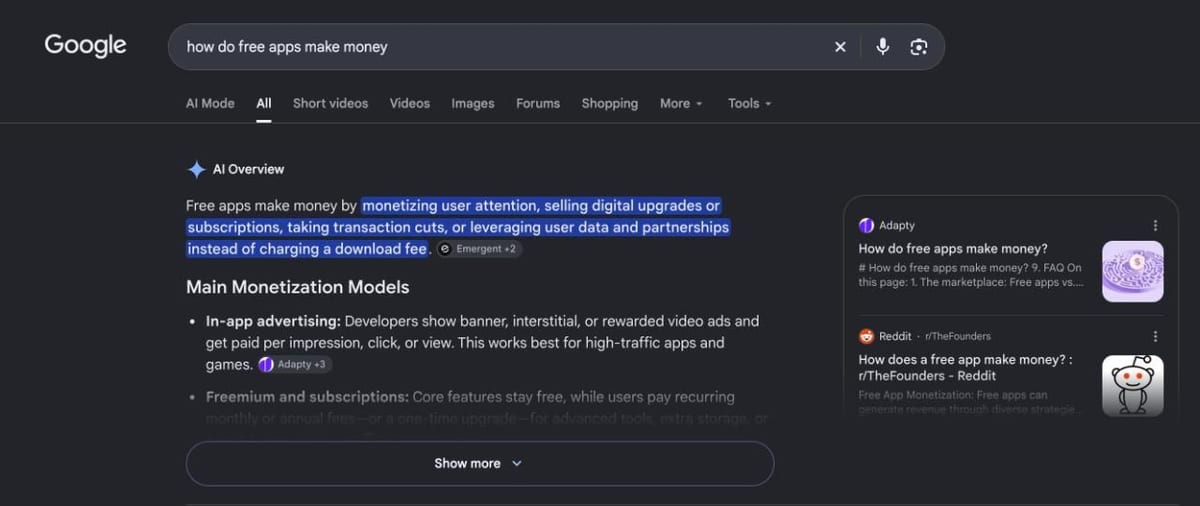
Google's answer for the query from Saudi Arabia, captured the day this post was written. It lists the models and says nothing about how users in the region can pay.
Which revenue model fits your kind of app?
The model that fits is the one that matches what your users already pay for. A game or a tool sells digital items, so purchases or a subscription fit. A shop, a clinic or a delivery business sells something physical, so the app takes orders and the money moves outside the store's billing.
| Model | What the user pays for | What the store keeps | Fits |
|---|---|---|---|
| Ads | Nothing: advertisers pay you | Not a store sale | Apps many people open every day |
| One-time purchase | A digital item or feature | 15% on the small-developer rate | Games, tools, content packs |
| Subscription | Ongoing digital access | 15% on the small-developer rate | Learning, fitness, media |
| Goods and services | An order, a booking, a delivery | Nothing: store billing is not allowed | Shops, restaurants, clinics, transport |
Source: Apple Small Business Program, Apple review guidelines, Google Play service fees and Google Play Payments policy, read 2026-11-21
Each model asks something of the app. Ads need people who come back often, or there is nothing to show an advertiser. A subscription needs a reason to keep paying: Apple's guidelines require ongoing value and a period of at least seven days. A one-time purchase needs one feature good enough to buy.
Sell something digital and both stores take a share. On their small-developer rates that share is 15%, set out in Apple's Small Business Program and Google Play's service fees, and both ask you to enrol. We went through the full fee table in what app stores really charge.
You can combine models. A free tier with ads and a paid tier that removes them is common. If you want no ads at all, the other three remain.
How will users in Saudi Arabia, the UAE and Egypt pay?
On Google Play they pay by card or on their phone bill, and the carriers differ by country. Google's country pages list Mobily, STC, Zain and Virgin for Saudi Arabia, du and Etisalat for the UAE, and Vodafone and e& for Egypt.
| Country | Cards Google Play lists | Phone bill carriers |
|---|---|---|
| Saudi Arabia | American Express, Mastercard, Visa | Mobily, STC, Zain, Virgin |
| UAE | American Express, Mastercard, Visa | du, Etisalat |
| Egypt | American Express, Mastercard, Visa | Vodafone, e& |
| Jordan, Lebanon | American Express, Discover, Mastercard, Visa | None listed |
Source: Google Play Help, accepted payment methods for Saudi Arabia, the UAE, Egypt and other countries, read 2026-11-21
Jordan and Lebanon have no section of their own on that page, so the last row is Google's list for every country it does not name. The table covers Google Play only.
Two lines on those pages matter if you plan a subscription. Google warns that some carriers cannot be used to pay for subscriptions and that prepaid numbers may not be supported. Where much of your audience pays on the phone bill, a one-time purchase is the safer first product.
Phone billing has limits of its own. The same Saudi page says it works only inside the Play Store app, and that the charge reaches the carrier account after 15 minutes. The UAE page adds that users may need to set a cap with their carrier first.
The Saudi list names American Express, Mastercard and Visa and does not mention mada. Test a mada card before launch instead of assuming.
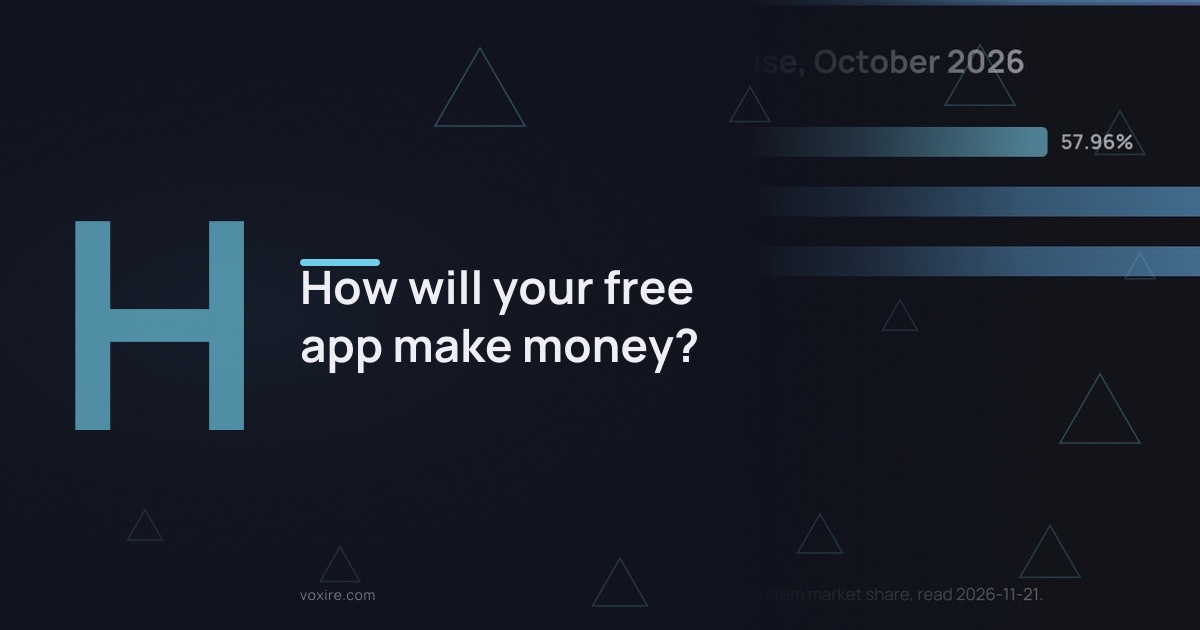
Google's rules reach most of your users in two of these markets. Android holds 57.96% of mobile use in Saudi Arabia, 80.69% in the UAE and 82.13% in Egypt, in StatCounter's figures for October 2026.
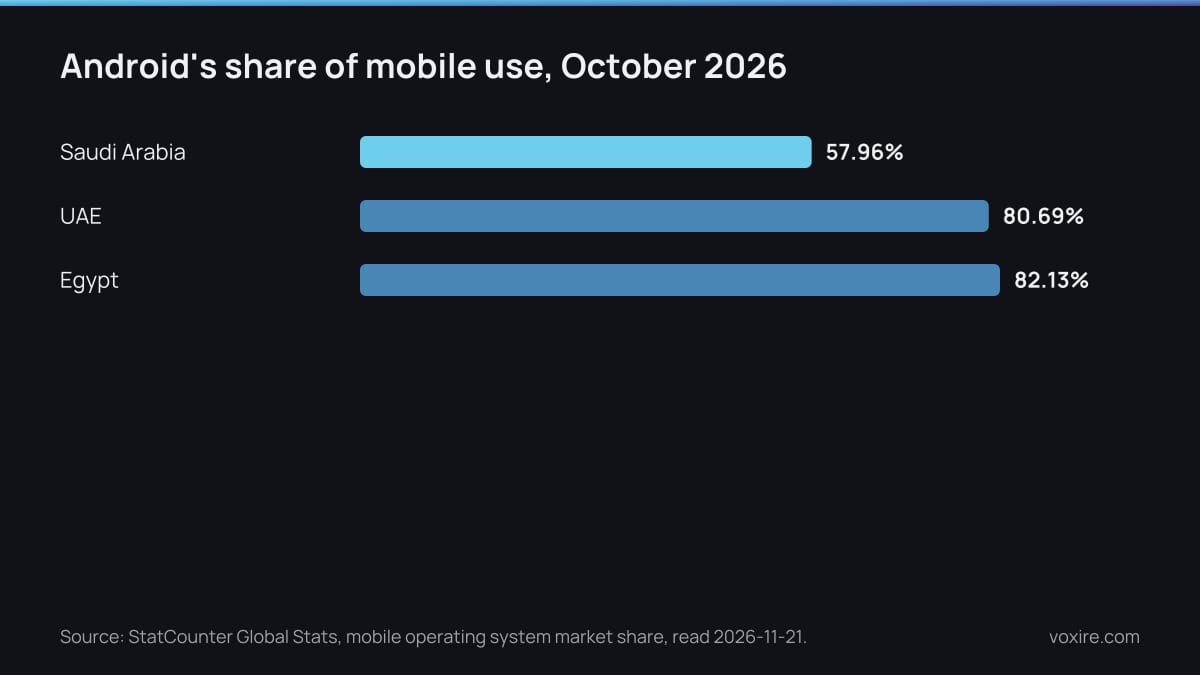
Android leads in all three, narrowly in Saudi Arabia and widely elsewhere.
How much does an app with 10,000 downloads make?
There is no fixed amount, because a download pays nothing and what happens afterwards decides everything. Of whatever those 10,000 people spend on digital items, the store keeps 15% on the small-developer rate. Ad income has no published rate at all.
Google's own AdMob page offers an earnings estimator and attaches a warning to it. There is no guarantee you will earn the amount shown, and real revenue depends on advertiser demand, where your users are, their devices and your category. Choose your own region in that estimator before you trust a figure from any article.
Treat per-download and per-user figures with care. The ad networks do not publish a rate card, and several of the guides we read for this post give ranges without naming a source. What is published is what this post is built on: the store's share, and how your users can pay.
Does a business app need a revenue model at all?
Usually not. An app for a restaurant, a clinic or a delivery business sells physical goods and services, and Apple's guidelines require those payments to use methods other than in-app purchase, such as Apple Pay or card entry. The app is a channel for the business, not a product with a price.
Google's Payments policy says the same from the other side. Its billing must not be used for physical goods, or for physical services such as transportation, cleaning, gym memberships, food delivery and tickets for live events. You collect through a payment gateway and pay its fee instead, which we compared in payment gateway fees for stores in the region.
Ads rarely belong in such an app. They send your own customers to someone else.
This is why the model comes first on our projects. A Voxire mobile app MVP starts from $8,000 and takes 8 to 14 weeks in our published pricing, and the payment flow is one of the first things specified. If you are still deciding who builds it, see an AI app builder or a developer.
What should you actually do this week?
This week, decide what your users will pay for and check how they can pay it. Both take an afternoon and neither needs a developer. The steps below are in the order we go through them with a founder before any design work starts.
- Write down what the user pays for. If it is physical, the app takes orders and the stores take no share.
- If it is digital, plan to enrol in Apple's Small Business Program and in Google Play's 15% tier on day one.
- List the countries your users are in and read Google's payment page for each. Note where phone billing exists.
- If you want subscriptions and your users pay on the phone bill, test with a postpaid and a prepaid SIM before launch.
- Before counting on ads, run Google's estimator for your region and category.
Sources
- Google Play Console Help: service fees, read 2026-11-21
- Google Play Console Help: Payments policy, read 2026-11-21
- Google Play Help: accepted payment methods, Saudi Arabia, read 2026-11-21
- Google Play Help: accepted payment methods, UAE, read 2026-11-21
- Google Play Help: accepted payment methods, Egypt, read 2026-11-21
- Apple: App Store Small Business Program, read 2026-11-21
- Apple: App Store review guidelines, read 2026-11-21
- Google AdMob, read 2026-11-21
- StatCounter: mobile operating system share, Saudi Arabia, read 2026-11-21
- StatCounter: mobile operating system share, UAE, read 2026-11-21
- StatCounter: mobile operating system share, Egypt, read 2026-11-21
Enjoying this article?
Enter your email and get a clean, formatted PDF of this article: free, no spam.
Not sure which model fits your app?
Tell us what the app does and where your users are. We will tell you which model fits, how your users can pay, and what the build costs before you commit to anything.
→ Mobile App Development → Get a Free Quote → Chat on WhatsApp
Voxire
Mobile App Development
React Native and native iOS and Android for MENA. RTL support done properly, regional payment integration, App Store and Play Store submission, and the architecture decisions that keep a small app maintainable.
Learn more