When one cross-platform build is enough, when two native apps pay back, and which phones your customers across the region actually carry.
Two quotes for the same app often disagree because one prices a single build and the other prices two. The single build is a cross-platform app: one codebase, shipped to both the App Store and Google Play. The other is a pair of native apps, one written for iPhone and one for Android. We settle this choice at the start of every mobile app project, because it sets the budget, the team and the yearly upkeep.
For most businesses in the region the answer is the same. Build once, unless the app leans hard on the phone itself. The reasons follow, with the figures for Saudi Arabia, the UAE, Egypt, Jordan and Lebanon.
What does cross-platform app development mean for an owner?
Cross-platform app development means one team writes one codebase and publishes it as two store apps, one for iPhone and one for Android. JetBrains, which makes one of these toolkits, states the gain plainly in its framework guide: shared code is written once, so every feature and every fix reaches both platforms together.
You still own two store listings, hold two developer accounts and pass two reviews. What you stop paying for is the second team. The account fees are covered in what app stores really charge.
A cross-platform app is not a website in a wrapper. Apple's review guidelines turn away apps that are a repackaged website, under the rule it calls Minimum Functionality. Flutter and React Native, the two toolkits most teams use, produce real apps. They install from the store, use the camera and send notifications.
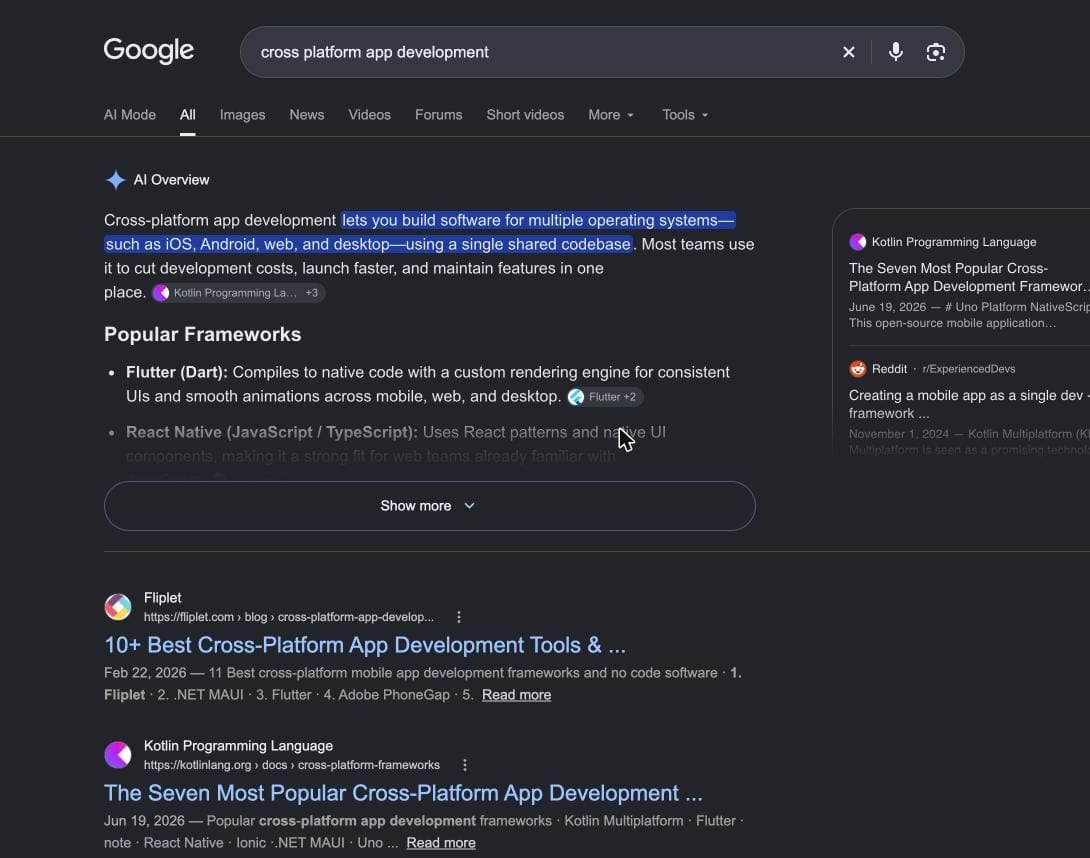
Google's first page for the query from Saudi Arabia, captured the day this post was written. It ranks toolkits for developers and leaves the owner's decision out.
How much does it cost to develop a mobile app?
A first version built once for both phones costs $8,000 to $12,000 at Voxire and takes 8 to 14 weeks, in our published pricing. A full consumer or enterprise app, with an admin dashboard, Arabic and English, and local payment gateways, runs $15,000 to $30,000 over 4 to 6 months.
Those prices assume one codebase. Ask for two native apps and you pay for two builds of every screen, two rounds of testing and two teams to keep in step. No honest quote for that matches the single-build figure.
So read every quote for the route it prices. If it does not say, ask before you compare it with another. How the work is staged after that is in how mobile app development works, step by step.
Which phones do your customers carry in each country?
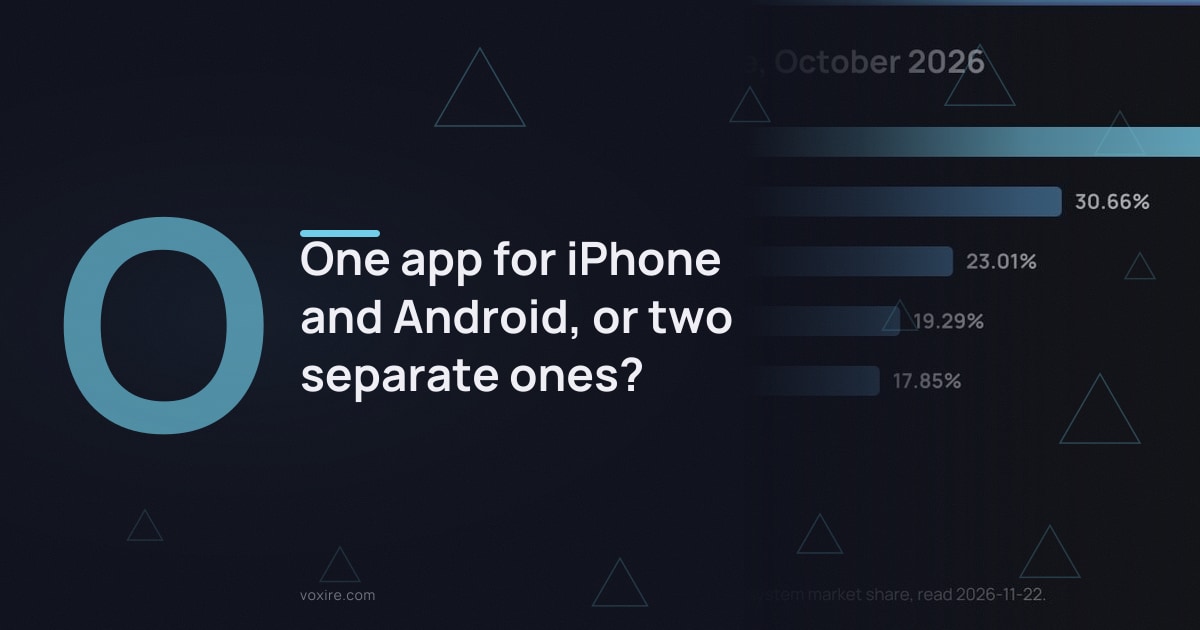
Most carry Android, but the gap changes sharply from one country to the next. iPhone holds 42.03% of mobile use in Saudi Arabia and 17.85% in Egypt, in StatCounter's figures for October 2026. An app for either market needs both phones on launch day.
| Country | Android | iPhone |
|---|---|---|
| Saudi Arabia | 57.96% | 42.03% |
| Lebanon | 69.34% | 30.66% |
| Jordan | 76.99% | 23.01% |
| UAE | 80.69% | 19.29% |
| Egypt | 82.13% | 17.85% |
Source: StatCounter Global Stats, mobile operating system share by country for October 2026, read 2026-11-22
This is the regional case for one build. Launch on Android alone in Saudi Arabia and you miss about four phones in ten, on StatCounter's count. Launch on iPhone alone in Egypt and you miss most of the country. One codebase covers both without a second budget.
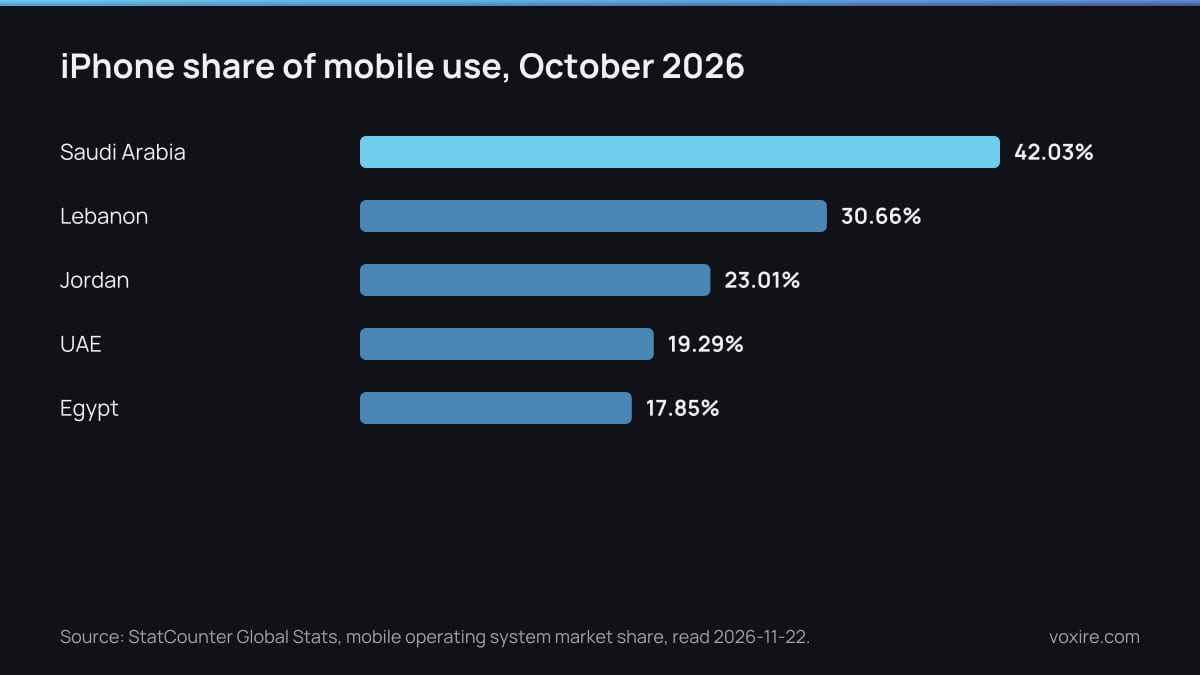
iPhone use is strongest in Saudi Arabia and weakest in Egypt, and in no market is either phone small enough to skip.
These figures measure use by phone type, not spending. Check them against your own customers. Your website analytics or your order history will show which phones they hold.
Is React Native still relevant in 2026?
Yes, React Native is still relevant, and some of the largest app makers ship with it. Its own showcase lists Facebook, Microsoft Outlook, Microsoft Teams and Amazon Shopping. Meta has also rebuilt its core, a change it calls the New Architecture, which removes an older layer between the app's code and the phone.
Flutter, from Google, is the other common choice. Its showcase includes Google Pay, Toyota and talabat, the food delivery app used across the Gulf, Egypt and Jordan. Flutter's page says talabat moved from separate native teams to a single Flutter codebase and got faster releases. That is the decision in this post, taken by a regional company at scale.
| Route | Backed by | Released | Apps named on its own showcase | What you fund |
|---|---|---|---|---|
| React Native | Meta | 2015 | Facebook, Microsoft Outlook, Amazon Shopping | One team, one codebase |
| Flutter | 2017 | Google Pay, Toyota, talabat | One team, one codebase | |
| Kotlin Multiplatform | JetBrains | Stable since 2023 | Not read for this post | Shared logic, shared screens optional |
| Two native apps | Apple and Google | With each platform | Not applicable | Two teams, two codebases |
Source: JetBrains framework guide, React Native showcase and Flutter showcase, read 2026-11-22
Which of the two should your developer use? The one their team already ships with. Both reach the same phones, and both handle Arabic. React Native documents its right-to-left layout support for languages like Arabic, and Flutter covers the same ground in its internationalization guide. Arabic alone is never a reason to build twice.
Voxire builds on React Native, one codebase for iPhone and Android, as our service page states. If you are choosing a team by framework, our Flutter and React Native comparison goes deeper.
When do you need two native apps?
You need two native apps when the app's main job depends on the device itself, not on screens and forms. Think of heavy camera or video processing, games, augmented reality, or an app that must adopt a new Apple or Android feature the week it ships. A shop, a booking app or a delivery app is not on that list.
Even then the choice is not all or nothing. Flutter documents how a shared app calls native code through what it names platform channels. JetBrains notes in its guide that most of these frameworks reach native features through plugins or bridges. A good team builds the one hard feature natively and shares the rest.
Ask any developer who recommends two native apps one question. Which feature in your brief cannot be built in a shared codebase? If the answer is vague, the second app is cost without a reason.
What changes every year after launch, whichever you pick?
Both stores raise their technical requirements every year, and your app must be rebuilt to keep up. Since April 28, 2026, Apple accepts only apps built with Xcode 26 or later. Since August 31, 2026, Google Play requires new apps and updates to target Android 16.
With one codebase that yearly update is done once. With two native apps it is done twice, by two teams, for as long as the app is live. Over a few years this is where the single build saves the most. It is also the line owners most often leave out of the budget.
A shared toolkit adds one dependency of its own, because the toolkit must keep pace with Apple and Google too. The two large ones are backed by Meta and Google. That is the practical reason to prefer them to a small toolkit with one company behind it. Our support after launch covers these operating system updates, billed monthly.
What should you actually do this week?
Start with your own customers: find out which phones they use, then ask every bidder which route their quote prices. Both take an afternoon and neither needs a developer. The steps below are the ones we go through with a founder before any design work starts.
- Open your website analytics or order history and note the split between iPhone and Android.
- Compare it with StatCounter's page for each country you sell in, starting from Saudi Arabia.
- Ask each developer whether the quote covers one codebase or two, and in which framework.
- If anyone proposes two native apps, ask which feature requires it.
- Ask who pays for the yearly store updates, and get the answer in writing.
- Read what a fixed-price app quote should include before you sign.
Sources
- StatCounter: mobile operating system share, Saudi Arabia, read 2026-11-22
- StatCounter: mobile operating system share, UAE, read 2026-11-22
- StatCounter: mobile operating system share, Egypt, read 2026-11-22
- StatCounter: mobile operating system share, Jordan, read 2026-11-22
- StatCounter: mobile operating system share, Lebanon, read 2026-11-22
- JetBrains: cross-platform app development frameworks, read 2026-11-22
- React Native: showcase, read 2026-11-22
- React Native: about the New Architecture, read 2026-11-22
- React Native: I18nManager, read 2026-11-22
- Flutter: showcase, read 2026-11-22
- Flutter: internationalizing Flutter apps, read 2026-11-22
- Flutter: platform channels, read 2026-11-22
- Apple: App Store review guidelines, read 2026-11-22
- Apple: upcoming requirements, read 2026-11-22
- Google Play Console Help: target API level requirements, read 2026-11-22
Enjoying this article?
Enter your email and get a clean, formatted PDF of this article: free, no spam.
Not sure which build your app needs?
Tell us what the app does and where your customers are. We will tell you whether one codebase is enough, which feature, if any, needs native work, and what the build costs before you commit to anything.
→ Mobile App Development → Get a Free Quote → Chat on WhatsApp
Voxire
Mobile App Development
React Native and native iOS and Android for MENA. RTL support done properly, regional payment integration, App Store and Play Store submission, and the architecture decisions that keep a small app maintainable.
Learn more