Many Lebanese businesses only think about website maintenance after something breaks. A proactive maintenance plan costs a fraction of emergency repairs, keeps your site secure and fast, and prevents the kind of downtime that costs you real customers.
Many Lebanese businesses only think about website maintenance after something breaks. A proactive maintenance plan costs a fraction of emergency repairs, keeps your site secure and fast, and prevents the kind of downtime that costs you real customers.
Why do Lebanese business websites break down?
A website is not a brochure you print once and file away. It is a system running on software that needs to be updated, security issues that need to be patched, and content that needs to stay accurate. When these things are neglected, problems accumulate quietly until they become visible crises.
Here are the most common ways Lebanese business websites degrade over time:
Outdated WordPress core, themes, and plugins. The majority of Lebanese business websites run on WordPress. WordPress releases security patches and updates regularly. Sites that are not updated within a reasonable window are vulnerable to attacks that can inject spam links, steal customer data, or take the site offline entirely. The 2025 WPScan vulnerability database listed over 30,000 known WordPress plugin vulnerabilities, most exploitable on unpatched sites.
Expired SSL certificates. When your SSL certificate expires, browsers display a terrifying red warning to every visitor before they can access your site. A 2024 survey found that 85% of users immediately leave a site showing an SSL warning. This can be set up to auto-renew, but it requires someone to monitor it.
Broken contact forms and email deliverability issues. Lebanon-hosted email often has delivery problems. If your contact form emails are landing in spam or not being sent at all, you are losing lead inquiries silently. This is one of the most common issues we find when auditing Lebanese business sites.
Hosting service changes. Many Lebanese businesses are hosted on local providers that have reliability issues due to the country's power and internet infrastructure challenges. Without monitoring, you may not know your site has been down for 12 hours until a client tells you.
Domain expiry. Lebanese businesses have lost their domains, and sometimes years of SEO equity, because a domain renewal email went to an old inbox nobody monitors. Domain expiry is a genuine business emergency.
Outdated content. A website showing COVID-era pricing, old team members who have left, or services you no longer offer actively hurts your credibility with potential clients.
What does a proper website maintenance plan cover?
A solid website maintenance plan for a Lebanese business should include the following:
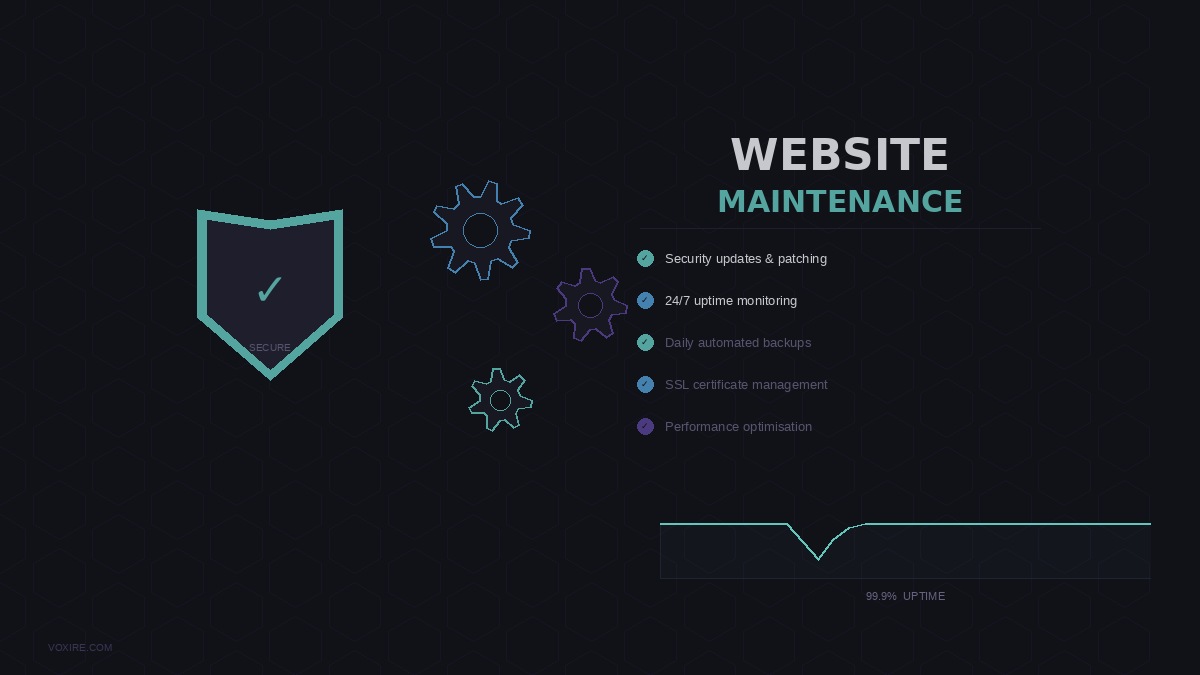
Security updates and patching. For WordPress sites, this means applying core, theme, and plugin updates on a regular schedule, typically monthly for standard updates and immediately for critical security patches. Each update should be tested before pushing to the live site.
Uptime monitoring. A monitoring tool checks your website every 1-5 minutes and sends an alert via SMS or email if the site goes down. Basic uptime monitoring services start at $10-$20 per month for a single site. Given Lebanon's infrastructure challenges, this is essential.
SSL certificate monitoring and renewal. Your SSL should auto-renew, but auto-renewal can fail. Proactive monitoring catches this before visitors see the warning page.
Backup management. Daily automated backups stored off-server (on S3 or similar cloud storage) so that if something goes catastrophically wrong, a hack, a bad update, an accidental deletion, you can restore a recent version within hours.
Performance checks. Monthly review of Google PageSpeed scores and Core Web Vitals. Site performance degrades over time as more scripts accumulate, image libraries grow, and the hosting plan ages. Catching degradation early is much cheaper than recovering from a site that has been penalized by Google for poor performance.
Content updates. Keeping pricing, contact details, team information, and service descriptions accurate. This also includes ensuring the sitemap and canonical URLs are correct as new content is added.
Broken link scanning. Internal and external links go dead over time. A regular scan identifies 404 errors and broken links before they frustrate users and harm your SEO.
Security scanning. Running a malware scan monthly to catch any injections or compromised files before they cause visible damage or get the site blacklisted by Google.
How much does website maintenance cost in Lebanon?
Maintenance costs in Lebanon vary depending on the provider, the complexity of your site, and what is included in the plan.
For a basic WordPress site (informational, no e-commerce), expect to pay $80-$150 per month for a solid maintenance plan covering updates, monitoring, backups, and basic content changes.
For a WordPress e-commerce site, the scope is larger because WooCommerce and payment gateway integrations add complexity. Expect $150-$300 per month.
For custom-built sites (React, Next.js, or other frameworks), maintenance typically involves code deployments and server management rather than plugin updates. Costs vary more widely but a reasonable baseline is $200-$400 per month depending on deployment frequency and included development hours.
Many local Lebanese web agencies offer retainer packages. When evaluating these, focus on what response time is promised for critical issues (a site that is down or hacked needs same-day response), what is included vs. billed hourly, and whether backups are stored offsite.
What is the cost of NOT maintaining your website?
This is where the math becomes stark for Lebanese business owners.
An emergency hack recovery for a WordPress site, cleaning malware, restoring from backup, hardening security, costs $300-$800+ and can take 1-3 days during which the site may be offline or showing malware warnings.
A domain that expires and gets caught by a domain squatter can cost $500-$2,000 to recover, if it can be recovered at all. In some cases, the domain is gone permanently and you lose all the backlinks and brand equity built on it.
Site downtime costs are direct: every hour a Lebanese e-commerce site is offline is an hour of lost sales. Even for service businesses, a day of downtime during a period when a potential client is trying to reach you is a missed opportunity with real revenue implications.
The cost of proactive maintenance is predictable and manageable. The cost of emergency recovery is unpredictable, high, and accompanied by the stress of a crisis.
Should you manage maintenance in-house or outsource it?
For most Lebanese businesses that are not tech companies, outsourcing maintenance to a specialist agency is the better option. Managing WordPress updates sounds simple until one update breaks a plugin and takes down a critical section of the site. A trained developer knows how to test updates in a staging environment, identify conflicts, and resolve them without causing downtime.
If you have an in-house developer, give them a documented maintenance checklist and the tools they need: an uptime monitor, a backup solution, and a staging environment. Maintenance done poorly by an internal person who has other priorities is often worse than no maintenance at all because it creates a false sense of security.
Questions to ask when hiring a maintenance provider in Lebanon
Before committing to a maintenance plan, ask these questions:
- What is your response time for critical issues (site down, hack, payment processing failure)?
- Where are backups stored and how often are they made?
- Do you test updates on a staging site before pushing to production?
- Is a staging/test environment included or extra?
- What is not included in the monthly fee?
- How do you handle updates that break things?
A provider that cannot answer these questions clearly is probably not running a structured maintenance process.
If you need a trusted team to handle ongoing maintenance and improvements rather than managing it in-house, Voxire offers web development in Lebanon covering everything from routine updates to performance optimization and feature additions.
Want a maintenance plan that actually covers you?
Voxire offers web maintenance plans for Lebanese businesses with transparent pricing, staged update testing, and same-day response for critical issues. Get in touch today and we will audit your current site's health for free before recommending a plan.
Enjoying this article?
Enter your email and get a clean, formatted PDF of this article: free, no spam.
Voxire
Web Development in Lebanon
Production web development for Lebanese businesses. Next.js and React builds, e-commerce, custom applications, bilingual Arabic and English from the first wireframe, USD pricing with fixed scope, and honest numbers on what a build costs here.
Learn more