Dokan, Sharetribe and a custom build priced for a Lebanese multi-vendor marketplace, with the vendor payout problem that Stripe-based tools leave open.
Most marketplace plans in Lebanon stall on a question no pricing page answers: how does the money reach every vendor? The software is the easy part. Dokan starts free inside WooCommerce, and Sharetribe rents you a hosted marketplace by the month. Both lean on Stripe for the vendor split, and Stripe's own country list does not include Lebanon.
The buyers are there. By late 2025, 91.8% of Lebanon's population was online, some 5.38 million people, according to DataReportal. What is missing is the plumbing between those buyers and dozens of small sellers. This post prices the three real routes from the side of the owner who has to pay vendors every week. Voxire builds marketplaces through its e-commerce development service in Lebanon, so the custom route comes with our published range.
How much does it cost to build a multi-vendor marketplace?
A working multi-vendor marketplace in Lebanon costs roughly $3,000 to $30,000 in build work, with platform licence fees on top. Where you land depends on the payout model, not the page count. Voxire's published price range puts an e-commerce store at $3,000 to $9,000 and a custom web application at $8,000 to $30,000.
The range is wide because a marketplace is three products at once. Buyers see a storefront. Each vendor needs a dashboard for stock, orders and earnings. You need a back office to approve sellers, settle commissions and handle refunds. A single-vendor store has only the first of the three. When Voxire scopes a marketplace, we price the vendor dashboard and the settlement ledger before the storefront, because those two decide whether the business survives its second month.
Dokan vs Sharetribe vs a custom build: which fits a Lebanese marketplace?
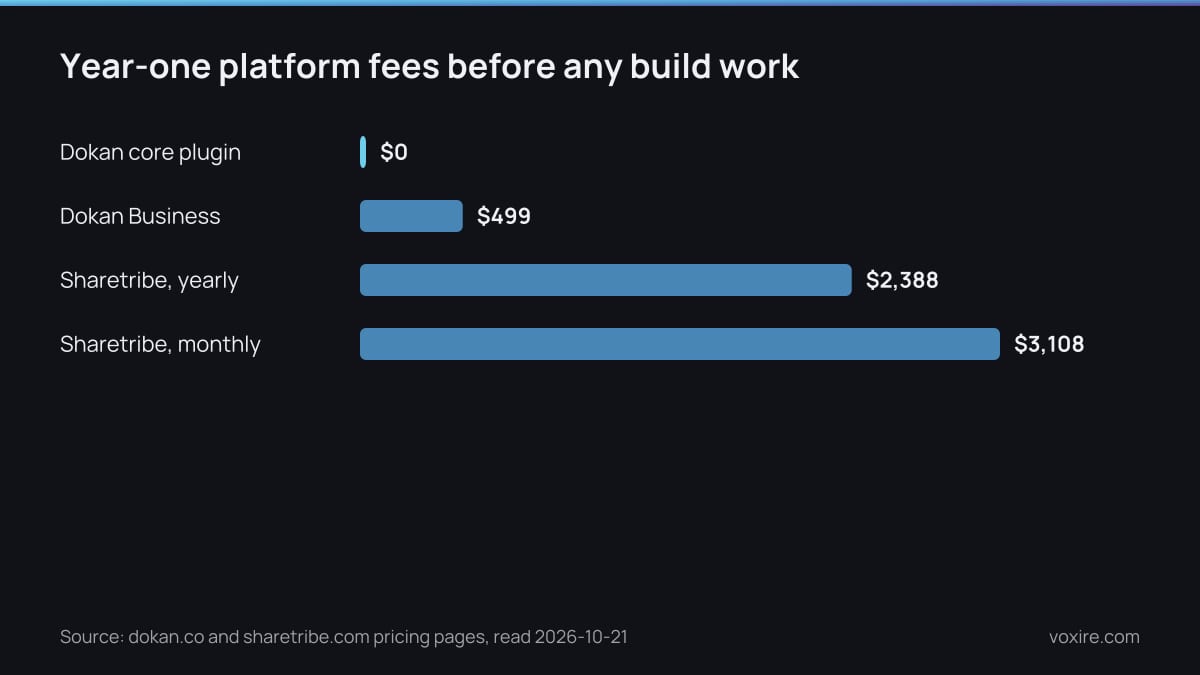
Dokan fits a product marketplace on a tight budget, Sharetribe fits service and rental marketplaces, and a custom build fits anyone whose payout or delivery rules break both. Dokan runs inside WooCommerce from $0, with paid tiers listed from $149 to $999 a year. Sharetribe charges $199 a month billed yearly for a live marketplace.
| Route | Year-one software | Build work | Vendor payouts from Lebanon | Best for |
|---|---|---|---|---|
| Dokan on WooCommerce | $0 core, $149 to $999 a year for paid tiers | Inside the $3,000 to $9,000 store range | Stripe Connect unavailable; manual withdrawals by bank or Whish | Product marketplaces, tight budget |
| Sharetribe | $2,388 billed yearly, $3,108 billed monthly | Setup plus any custom code you host yourself | Built on Stripe; needs a company where Stripe operates | Services and rentals, founders with an entity abroad |
| Custom build | Hosting only | Inside the $8,000 to $30,000 web application range | Any rail you integrate: bank, Whish, courier cash ledger | Your own payout, delivery and Arabic rules |
| Run it as one store first | Store platform only | Inside the $3,000 to $9,000 store range | You pay vendors by hand | Testing demand before you build |
Source: Dokan pricing, Sharetribe pricing, Voxire website cost guide, read 2026-10-21
On the Dokan route, Voxire's work is the part the plugin leaves out. That means Arabic and English vendor dashboards, delivery zones per vendor, and a withdrawal flow that matches how Lebanese sellers really get paid. On the custom route, we build the ledger first and the storefront second. If you are still choosing the underlying store platform, read Shopify vs WooCommerce in Lebanon before you commit.
Which payout rail works for a Lebanese marketplace without Stripe?
A ledger plus a local rail works: the marketplace collects every payment, records each vendor's share, and settles on a schedule by bank transfer or Whish. Lebanon is missing from Stripe's supported countries, so the automatic split that Dokan's Stripe Connect module and Sharetribe rely on is closed to a Lebanese company.
The ledger is simple arithmetic, and it is unforgiving. Dokan's own documentation walks through a $90 order with a 30% commission: the marketplace keeps $27, processing takes $4.26, and the vendor is owed $58.74. Without Stripe, your system has to hold that $58.74, show it on the vendor's dashboard, and release it on the agreed day. A refund then has to reverse it.
The payout rail is where Lebanon helps. Whish is licensed by Banque du Liban under Resolution No. 19/21/22 and lists more than 1,000 locations in Lebanon. That reach matters for small vendors without a bank account that works. On the buyer side, Tap accepts online card payments in Lebanon, and we compare the other gateways in Payment Gateway Lebanon 2026: Areeba vs Tap vs Whish.
Cash on delivery adds a second ledger. One courier bag can carry orders from three vendors, so every parcel needs a vendor tag before it leaves. On marketplace projects, Voxire builds the reconciliation screen early: courier cash in, commission out, vendor balance updated. Our delivery comparison for Lebanese stores covers the courier side.
How can I build a multi-vendor marketplace?
You build one in five steps: sign vendors, pick the payout rail, choose a platform that supports it, launch one category, then grow. The common mistake is spending the budget on software before a single seller has agreed to list. Sign the vendors and the code gets cheaper.
- Sign vendors before code. Get written commitments from your first sellers, with their product counts and how they want to be paid.
- Pick the payout rail. Bank transfer, Whish, or cash collected by courier. This choice decides the platform, not the other way round.
- Choose the platform. Dokan if manual withdrawals work for your sellers, a custom build if they do not. Sharetribe only if you hold a company where Stripe operates.
- Launch one category. One category keeps vendor support and delivery rules manageable while you learn.
- Add vendors as orders arrive. Shopify's marketplace guide recommends tracking active buyers, active sellers, gross merchandise sales and take rate from the start.
At Voxire, discovery for a marketplace starts with steps one and two. We ask for the vendor list and the payout rule before we quote a single screen.
What commission should a Lebanese marketplace charge?
Start between 10% and 20% on physical goods, then adjust once you know your delivery and payment cost per order. Shopify's marketplace guide puts Upwork's take rate at 19.4% and Etsy's consolidated take rate at 24.5%. Both include advertising and services that a new Lebanese marketplace will not offer at launch.
The rate has to cover what you really pay per order. In Dokan's worked example, $4.26 of a $90 order goes to processing alone. Add courier handling for cash on delivery, the refunds you absorb, and the hours spent on vendor support.
That is why Voxire builds commission as a setting per vendor and per category, never as a constant in the code. The first rate you pick is rarely the one you keep.
Should you test the idea before building a marketplace?
Yes: run your first month as a single store where you list vendors' products yourself and pay them by hand, then build marketplace software once orders justify it. That store sits inside Voxire's published $3,000 to $9,000 store range, and its catalogue later moves into Dokan or a custom build.
Local players already run open marketplaces. Soukly invites Lebanese stores to sell for free with Whish payments, so ask whether your niche beats a general marketplace before you fund a new one. If a developer is already quoting you, our guide to hiring an e-commerce developer in Lebanon covers what to check in the quote.
What should you actually do this week?
Write down your first ten vendors and how each one wants to be paid, then choose the platform from that list. That single page decides more of the budget than any feature list. It is also the first thing a serious developer should ask you for.
- Ask each vendor: bank account, Whish, or cash.
- Pick a starting commission and test it against one real order.
- Decide who pays the courier when one buyer orders from three vendors.
- Send the page to two developers and compare how each handles payouts.
Sources
- Dokan pricing, read 2026-10-21
- Dokan Stripe Connect documentation, read 2026-10-21
- Sharetribe pricing, read 2026-10-21
- Stripe global availability, read 2026-10-21
- Whish Money, read 2026-10-21
- Tap Payments Lebanon, read 2026-10-21
- DataReportal, Digital 2026: Lebanon, read 2026-10-21
- Shopify, multivendor marketplace guide, read 2026-10-21
- Soukly, read 2026-10-21
Need your vendor payouts mapped before you pick a platform?
Send us your vendor list and how each seller wants to be paid. We will tell you whether Dokan carries it or a custom ledger is cheaper over two years, and price the build against our published ranges.
→ E-commerce Development in Lebanon → Get a Free Quote → Chat on WhatsApp
Enjoying this article?
Enter your email and get a clean, formatted PDF of this article: free, no spam.
Voxire
Web Development in Lebanon
Production web development for Lebanese businesses. Next.js and React builds, e-commerce, custom applications, bilingual Arabic and English from the first wireframe, USD pricing with fixed scope, and honest numbers on what a build costs here.
Learn more