What an AI chatbot on your website should answer, when it must hand the visitor to a person, and what the main options cost in the first year.
A chatbot on your website speaks for your company, and a tribunal has already said so. In February 2024, British Columbia's Civil Resolution Tribunal ordered Air Canada to pay C$812.02 after its website chatbot described a refund rule the airline did not have.
We are a web development team in Beirut, and this autumn we built an AI assistant into a property listings platform. Its first rules were written before its first prompt. Never quote a price that is not on the listing, never negotiate, and hand the buyer to an agent once money is on the table. This post explains those rules, prices the options, and lists what to check before you switch one on.
What should an AI chatbot on a business website answer?
A website chatbot should answer only questions whose answers you already publish: listing facts, opening hours, documents needed, payment milestones and how to book a visit. Discounts, legal advice and promises about availability belong to a person. That one rule keeps every reply checkable against a page you control, which matters when a visitor screenshots the answer.
The technical word for this is grounding. The bot reads your own pages and records before it replies, instead of answering from whatever the model learned elsewhere. It still makes mistakes. Vectara's hallucination leaderboard, updated on 22 October 2026, finds that even the best model it tested adds unsupported content to 1.8% of summaries of a document it was handed. Grounding narrows the errors; it does not remove them.
On our listings build, the assistant reads each residence's published record: price, area, handover date and payment plan. When a visitor comments on a post with a price question, the reply comes from that record and nothing else. If the record has no answer, the bot says so and offers an agent. That refusal is a feature, not a gap.
Should a website chatbot quote prices?
Yes, but only the price already printed on the listing or price page, word for word, with the date it was last updated. A chatbot should never estimate, round, convert or discount a price. In Lebanon, where sellers quote in fresh dollars and asking prices move often, a stale figure costs more trust than no figure at all.
Negotiation is the hard line. A visitor who types "what is your best price?" is a hot lead, not a support ticket. Our assistant answers with the published price and the payment plan milestones as they appear on the listing. Then it routes the conversation to an agent with the listing attached. It never agrees to a number.
The same rule covers anything that looks like a price. Service fees, commission, maintenance charges and transfer costs all count. If the figure is not on a page you published, the bot should not invent it, even politely.
Who is responsible when a website chatbot gives a wrong answer?
The business is, according to the first tribunal to rule on it. In Moffatt v. Air Canada, the airline argued its chatbot was responsible for its own words, and the tribunal called that a remarkable submission before ordering C$812.02 in damages, interest and fees. We know of no Lebanese ruling yet, but the reasoning travels easily.
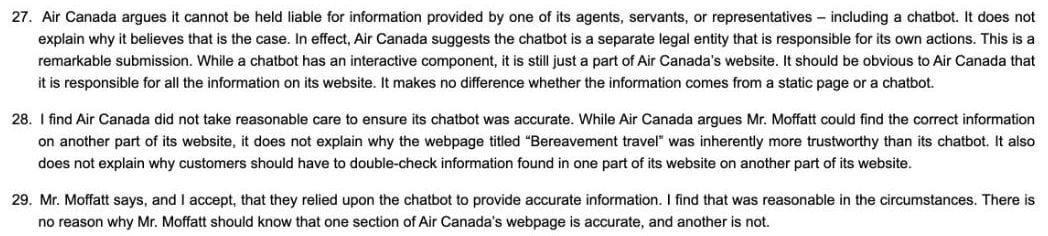
Paragraphs 27 to 29 of Moffatt v. Air Canada, 2024 BCCRT 149, decided 14 February 2024. Screenshot taken 2026-11-01.
The tribunal's point is that a customer cannot be expected to know which part of your website is accurate. A chatbot answer weighs the same as your price page. So the safe design makes the chatbot unable to say anything your pages do not already say, and logs every reply so you can check it later.
Collecting names and phone numbers through the chat also brings Lebanon's Law 81 of 2018 on electronic transactions and personal data into play. Our enquiry intake stores which version of the consent text each visitor saw. If anyone asks later what the person agreed to, the answer is one record away.
How much does an AI chatbot for a website cost?
A ready-made AI chatbot costs $40 to $500 a month on Chatbase's published plans, while Intercom charges $0.99 per Fin outcome plus seats. An outcome is roughly a conversation Fin resolves. At 1,000 answered chats a month, the pricing model decides the bill more than the features do.
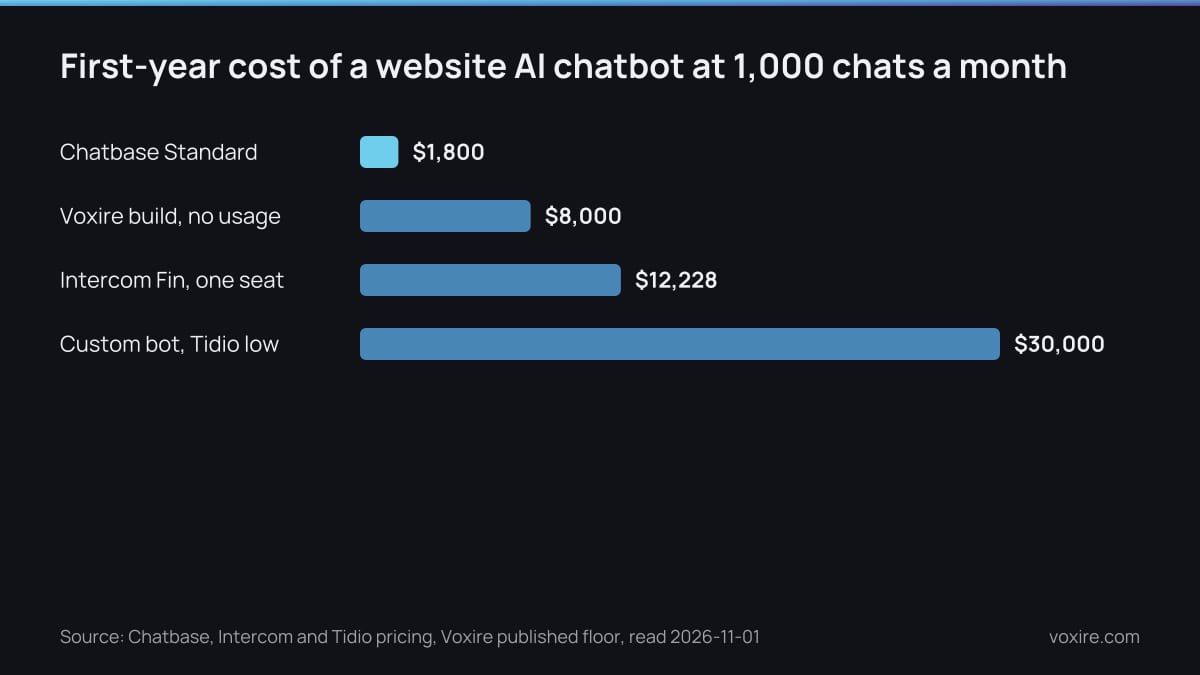
First-year cost at 1,000 chats a month, assuming about four messages per chat and every chat counted as a Fin outcome. Data from Chatbase, Intercom, Tidio and Voxire, read 2026-11-01
| Option | How you pay | Year one at 1,000 chats a month | Who enforces the rules |
|---|---|---|---|
| Chatbase Standard | $150 a month for 4,000 message credits | About $1,800 | You, in its settings |
| Intercom Fin on Essential | $0.99 per outcome plus $29 per seat a month | About $12,228 with one seat | You, in its settings |
| Custom AI chatbot, market range | One-off build plus running costs | $30,000 to $120,000 to build | The build team |
| Voxire, built into your site | Custom web application, model usage billed at cost | From $8,000 plus usage | Written with you, enforced in code |
Source: Chatbase pricing, Intercom pricing, Tidio chatbot pricing guide, Voxire web development pricing, read 2026-11-01
The tools are cheaper in year one, and for many sites they are the right answer. The difference is where the rules live. In a tool, a rule is a setting someone can switch off. In our build, the price guardrail is code, so the bot cannot quote a figure the listing record does not hold.
Should you buy a chatbot tool or build one on your own data?
Buy a tool when your answers sit in a few stable pages; build when they live in records that change weekly, like listings or stock. Tidio puts a custom AI chatbot at $30,000 to $120,000, and most of that is the data pipeline. If your website already has structured records, much of that work is done.
That was our case. The listings platform already had a CMS with drafts, review and publishing, so the assistant reads the same published record a buyer sees. A hosted tool would have needed the listings uploaded again every time a price moved. Tidio's own model shows a typical $90,000 custom bot carrying about $4,900 a month in fixed costs before it answers anything. We avoid that by building on data the site already keeps.
For a company site with ten pages that rarely change, we tell clients to buy a tool. Spend the saving on the pages the bot reads. Our corporate websites run $1,500 to $4,000, and clear pages make any chatbot better.
When should the chatbot hand the visitor to a person?
Hand over the moment a visitor asks about money beyond the published price, asks twice without an answer, or leaves a phone number. A Gartner survey of 5,728 customers found 60% fear AI will make it harder to reach a person, so the handoff is what visitors judge you on.
First impressions stick. Gartner reported in September 2026 that only 27% of customers would try a company's chatbot again after a negative experience. A bot that loops on the same wrong answer burns that one chance.
In Lebanon the person taking over usually works on WhatsApp, not in a helpdesk. Our handoff opens a WhatsApp chat with the listing and the transcript attached, so the agent starts where the bot stopped. When the model times out, a Try again button re-sends the same question instead of making the visitor type it again. For the inbox on the agent's side, compare WATI, respond.io and a custom inbox.
Test the handoff in three scripts. Lebanese visitors write in Arabic, in English, and in Arabic typed with Latin letters. A bot that only handles the first two will hand off half the hot leads by accident.
What should you actually do this week?
Write the rulebook before you pick a tool: one page that lists what the bot may answer, what it must never say, and who receives the handoff. Every option in the table above can be set up from that page. Without it, you are buying a bot that improvises in your company's name.
- Export the ten questions your sales team answers most on WhatsApp.
- Mark each one as answered on a published page, or needing a person.
- Check that every price on your site shows when it was last updated.
- Name the person who receives handoffs, with their WhatsApp number.
- Ask each vendor to show the bot refusing a discount request before you sign.
If your answers already live in a CMS, see what a listings platform built from Beirut costs. If WhatsApp is where most questions arrive, start with our guide to WhatsApp chatbots for Lebanese businesses.
Sources
- Civil Resolution Tribunal, decision 2024 BCCRT 149 (Moffatt and Air Canada), read 2026-11-01
- Gartner, Survey finds 64% of customers would prefer that companies didn't use AI for customer service, read 2026-11-01
- Gartner, Only 27% of customers would try a chatbot again after a negative experience, read 2026-11-01
- Vectara, Hallucination leaderboard, read 2026-11-01
- Tidio, Chatbot pricing in 2026, read 2026-11-01
- Intercom, Pricing, read 2026-11-01
- Chatbase, Pricing, read 2026-11-01
Want an assistant that only says what your website says?
Send us the ten questions your team answers most and where those answers live today. We will tell you whether a tool is enough or a build pays back, and quote it in USD with the price and handoff rules written in.
Enjoying this article?
Enter your email and get a clean, formatted PDF of this article: free, no spam.
Voxire
Web Development
Custom websites, Next.js and React applications, and the engineering decisions behind sites that stay fast under real traffic. Core Web Vitals, headless CMS choices, migrations, and what performance work is actually worth paying for.
Learn more