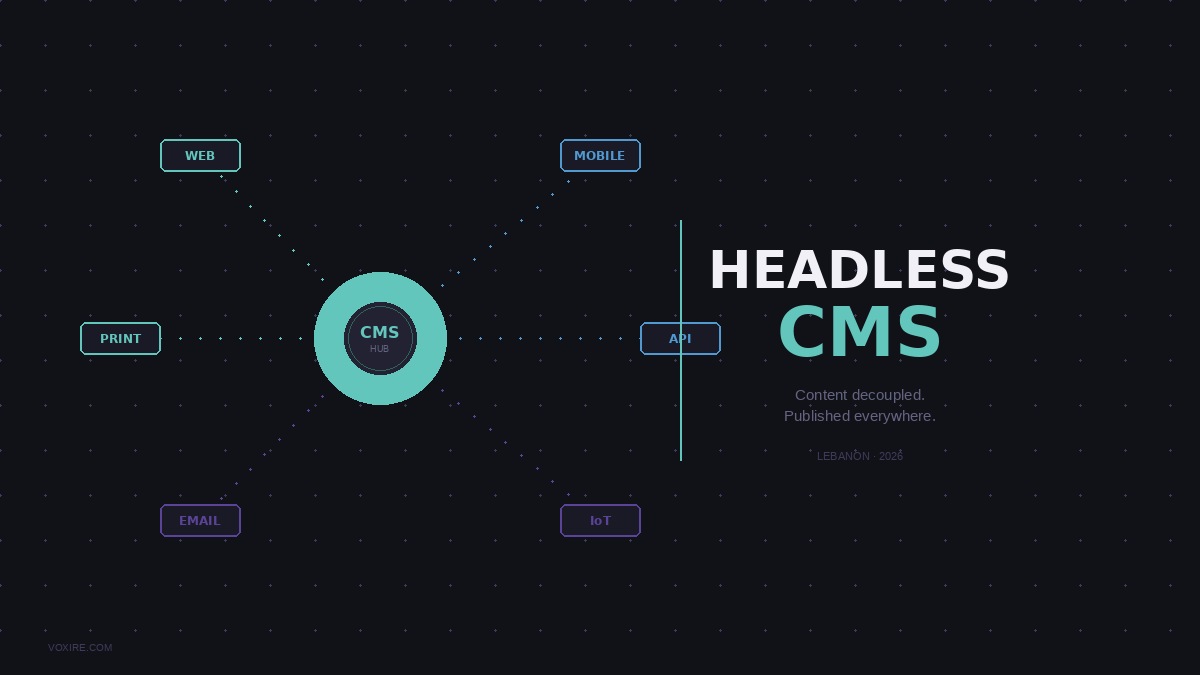
A headless CMS separates your content from your website's front-end, giving Lebanese businesses faster load times, greater design freedom, and easier multi-channel publishing. Here is what you need to know before making the switch.
A headless CMS separates your content from your website's front-end, giving Lebanese businesses faster load times, greater design freedom, and easier multi-channel publishing. Here is what you need to know before making the switch.
What exactly is a headless CMS?
A traditional CMS like WordPress bundles two things together: a back-end system that stores your content and a front-end layer that displays it. The "head" refers to that front-end presentation layer: the HTML, CSS, and JavaScript that visitors see in their browsers.
A headless CMS removes that front-end layer entirely. It stores and manages your content through a clean admin interface, then delivers it anywhere you need via an API. Your developers can build the front-end using any technology they choose: React, Next.js, Vue, a mobile app, a digital signage screen, or even a WhatsApp chatbot. The CMS simply provides the raw content on demand.
Think of it this way: a traditional CMS is a restaurant that only serves dine-in. A headless CMS is a professional kitchen that accepts orders from any delivery platform, any pop-up location, and any catering event simultaneously.
How does a headless CMS compare to WordPress?
WordPress powers roughly 43% of all websites globally, and for good reason: it is easy to set up, has thousands of themes, and most Lebanese web developers know it well. But it has real limitations that become obvious as your business scales.
With WordPress, your content is tightly coupled to your theme. Changing your design means touching content templates. Going multilingual, critical in Lebanon where sites often need Arabic, English, and French, requires plugins that add complexity and slow things down. Publishing the same content to your website and your mobile app means duplicating work.
A headless CMS solves these problems by design. Your content team manages everything from one place, and that content flows wherever your developers have built a connection. Popular headless options in 2026 include Contentful, Sanity, Strapi (open-source and self-hostable), Directus, and Payload CMS.
The trade-off is technical complexity. A headless setup requires a developer to build and maintain the front-end. If your team manages the website through WordPress themes and page builders today, switching to headless adds a layer that your non-technical team cannot easily manage without the developer on call.
Who actually benefits from going headless in Lebanon?
Going headless makes the most sense for Lebanese businesses in these situations:
E-commerce brands with an app and a website. If you are running a Shopify or custom store alongside a React Native mobile app, a headless CMS lets your content team publish product descriptions, banners, and promotions once and have them appear correctly on both platforms.
Media publishers and news sites. Lebanese news and media outlets that need to publish Arabic and English content at high volume benefit significantly. A headless CMS with strong API support makes it easy to distribute content to a website, AMP pages, push notifications, and social media integrations from one dashboard.
Startups building SaaS products. If your core product is a web app built in React or Next.js, managing your marketing website and blog in a headless CMS like Sanity keeps everything in the same technical ecosystem rather than running a separate WordPress installation.
Businesses focused on performance. Because headless front-ends are typically built with modern frameworks using static generation or server-side rendering, they often score significantly better on Google's Core Web Vitals than equivalent WordPress sites loaded with plugins.
What are the real costs of going headless?
Lebanese business owners should go in with clear expectations about costs.
The CMS itself can range from free (Strapi, Directus, Payload on your own server) to $500+ per month for enterprise plans on Contentful. For most small-to-medium Lebanese businesses, an open-source option hosted on a VPS or a mid-tier Sanity plan (free for smaller projects) is enough.
The bigger cost is development. Building a headless front-end from scratch takes more time than installing a WordPress theme. Plan for 4-8 weeks of initial development for a well-structured marketing site, and budget for ongoing developer support when you need design changes. Unlike WordPress, you cannot just swap themes.
Hosting for the front-end is often cheaper than a fully loaded WordPress setup: platforms like Vercel, Netlify, and Cloudflare Pages offer generous free tiers for static and server-rendered front-ends.
What about multilingual support: Arabic, English, and French?
This is where a headless CMS genuinely shines for Lebanese businesses. Managing a multilingual site in WordPress requires plugins like WPML or Polylang, which add significant overhead, are not always reliable after major updates, and can complicate your URL structure.
Headless CMS platforms like Sanity and Contentful have localization built into their content model. You define that a field (say, a page title or a product description) exists in Arabic, English, and French, and your content team fills in each version from the same editing screen. The API then returns the correct language based on whatever the front-end requests. RTL Arabic layouts are handled entirely by your front-end CSS, not by the CMS, which is actually cleaner.
The performance argument for Lebanese websites
In Lebanon, where mobile data can be expensive and connections are inconsistent in some areas, website performance is not just a Google ranking factor: it is a direct business concern. Visitors on slower connections will leave a site that takes four or five seconds to load.
Headless architectures built on Next.js or Astro with static generation load extraordinarily fast because they serve pre-built HTML files rather than assembling pages dynamically on every request. A well-built headless site can reliably hit sub-2-second Largest Contentful Paint scores that even optimized WordPress sites struggle to match.
Should you switch your existing WordPress site to headless?
Not necessarily. If your current WordPress site is fast, well-maintained, and your team can manage it independently, switching to headless for its own sake adds cost and complexity without proportional gain.
Consider going headless if:
- You are rebuilding your site from scratch and have development resources
- You are launching a mobile app alongside your website and need a single content source
- Your WordPress site is slow and plugin-heavy and a rebuild is already on the roadmap
- You need serious multilingual support across Arabic, English, and French
Stick with WordPress (or upgrade to a well-optimized WordPress setup) if:
- Your content team manages the site independently without developer support
- Your site is primarily informational with infrequent updates
- Budget is tight and you need to minimize ongoing development costs
How Voxire approaches headless CMS projects
At Voxire, we have built headless setups for Lebanese e-commerce brands and media clients using Sanity with Next.js, as well as Strapi for clients who need full data ownership on their own infrastructure. We also help businesses evaluate honestly whether their current WordPress setup just needs optimization rather than a full rebuild.
The honest answer is that a headless CMS is a powerful tool, but it is not the right tool for every Lebanese business in 2026. The best solution depends on your team's technical capacity, your content publishing volume, and whether you are serving content across multiple channels.
Choosing the right CMS architecture is a decision that compounds over time. Voxire's web development in Lebanon team builds headless and traditional CMS implementations for Lebanese businesses that prioritise performance, flexibility, and long-term maintainability.
Enjoying this article?
Enter your email and get a clean, formatted PDF of this article: free, no spam.
Not sure which CMS architecture is right for your business?
Voxire helps Lebanese businesses make the right technology decisions: whether that means a properly optimized WordPress site, a headless Next.js build, or something in between. Book a free consultation and we will give you a straight answer based on your actual needs. Get in touch with Voxire today
Voxire
Web Development
Custom websites, Next.js and React applications, and the engineering decisions behind sites that stay fast under real traffic. Core Web Vitals, headless CMS choices, migrations, and what performance work is actually worth paying for.
Learn more