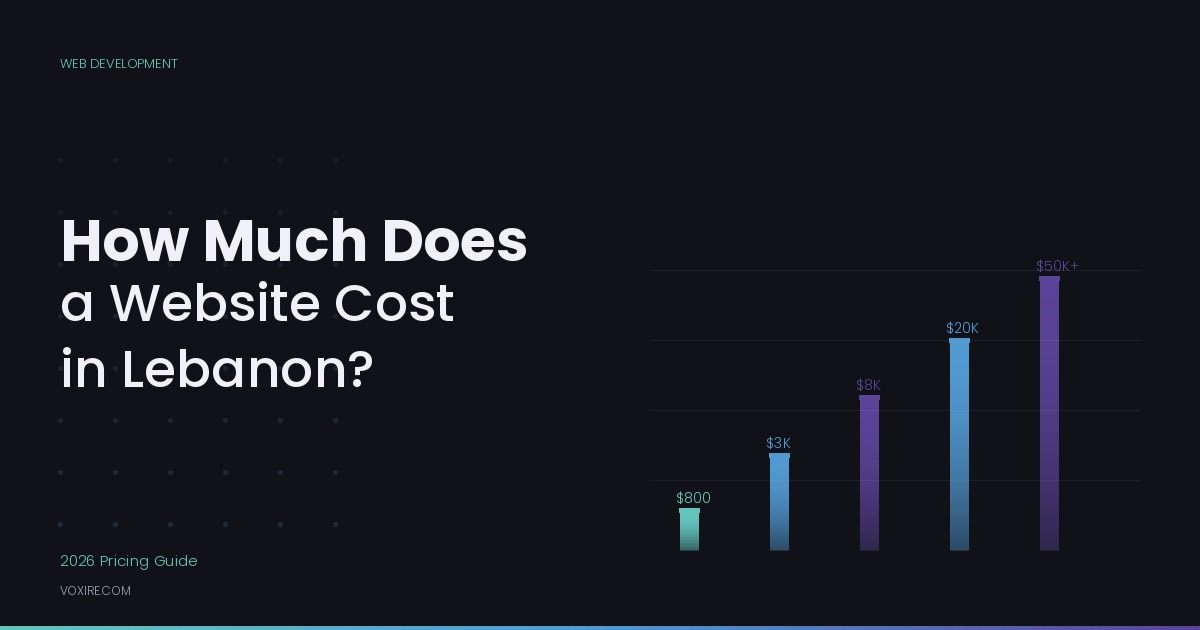
How much does a website cost in Lebanon? It is the first question every Lebanese business owner asks and rarely gets a straight answer to. This guide breaks down real pricing for every type of website Lebanese businesses actually need in 2026, from simple landing pages to full e-commerce stores and custom web applications.
How much does a website cost in Lebanon? It is the first question every Lebanese business owner asks and rarely gets a straight answer. Prices vary wildly, and the range between a freelancer on Upwork and a Beirut-based digital agency can be enormous. This guide cuts through the confusion with real pricing ranges for every type of website Lebanese businesses need in 2026, plus the factors that move prices up or down, and how to evaluate whether you are getting value for what you pay. For the services hub itself, see Voxire's web design in Lebanon page for project scoping and engagement model. See also: SEO Cost in Lebanon for the topic-specific playbook. See also: School and University Website Design in Lebanon for the topic-specific playbook.
What factors determine website cost in Lebanon?
Before looking at specific pricing, understanding what drives website costs in Lebanon helps you evaluate any quote you receive. The main factors:
Scope and complexity: A five-page brochure site for a Beirut restaurant has a fundamentally different build cost from a custom e-commerce platform handling hundreds of products, multiple currencies, and Arabic-English switching. Scope is the single biggest cost driver.
Who builds it: A student freelancer, a mid-career freelance developer, a boutique Lebanese digital agency, and a regional agency serving GCC markets will quote the same project at vastly different prices. Each has trade-offs in reliability, quality, speed, and ongoing support. See also: Freelance digital marketing in Lebanon in 2026 for the topic-specific playbook.
Design approach: Websites built on premium templates cost significantly less than fully custom designs. Template-based sites are not inferior, many perform extremely well, but custom design is a premium service.
Content management: A website with a content management system (CMS) that your team can update without a developer costs more upfront but saves money long-term. A static HTML site requires developer involvement every time you want to change text or images.
Integrations: Adding payment processing, booking systems, CRM connections, email marketing integrations, or multilingual support each add cost. The more external systems your site needs to talk to, the higher the build cost.
Hosting and maintenance: Web design cost in Lebanon is often quoted without hosting and ongoing maintenance, which are recurring expenses. Factor these into your total cost of ownership calculation. For the full price spectrum across every type of Lebanese website project, from $0 DIY builds through $20,000+ custom platforms, see our website cost guide for Lebanon.
How much does a basic website cost in Lebanon?
A basic business website, five to ten pages covering home, about, services, contact, and maybe a blog, is the entry point for most Lebanese businesses establishing an online presence.
Lebanese freelancer route: $500 to $1,500 USD. This gets you a template-based site, usually on WordPress, built by an individual developer. Quality varies significantly by developer. The risk: limited ongoing support, slower turnaround times, and potential availability issues if the developer takes on other commitments. The reward: lowest upfront cost.
Small Lebanese agency route: $2,000 to $5,000 USD. A proper discovery process, custom or heavily customized design, mobile-first build, basic SEO setup, and handover training. You get a point of contact, a project timeline, and accountability. This is the sweet spot for most Lebanese SMEs wanting a professional result.
Mid-tier Lebanese digital agency: $5,000 to $12,000 USD. Strategic positioning, full custom design, performance optimization, Arabic-English bilingual implementation, and structured ongoing support. This range is appropriate for Lebanese businesses where the website is a primary revenue driver.
Enterprise / GCC-facing agencies: $15,000 and above. Full branding integration, custom development, multilingual support across Arabic, English, and French, enterprise CMS, and an ongoing retainer for maintenance and marketing. Lebanese businesses expanding into Gulf markets often require this level of execution.
How much does an e-commerce website cost in Lebanon?
E-commerce websites cost more than brochure sites because they include significantly more functionality: product catalog management, shopping cart, checkout flow, payment processing, order management, and often inventory tracking.
Shopify template build: $1,500 to $4,000 USD. A Shopify store set up on a premium theme, configured with your products, payment gateway connected, and shipping rules set up. Suitable for Lebanese businesses with up to several hundred products who want to launch quickly and manage inventory easily. Monthly Shopify fees run $39 to $399 USD depending on the plan.
WooCommerce custom build: $3,000 to $8,000 USD. A WordPress-based e-commerce store with custom design and WooCommerce functionality. More flexibility than Shopify and no ongoing platform fees, but requires more developer involvement for updates and maintenance. Best for Lebanese businesses with specific functional requirements that standard Shopify themes do not accommodate. See also: WordPress Website Cost in Lebanon 2026 for the topic-specific playbook.
Custom e-commerce platform: $15,000 to $50,000+ USD. Fully bespoke checkout flows, complex product configurators, multi-warehouse inventory, B2B pricing tiers, or advanced marketplace features. This range applies to Lebanese businesses with high transaction volumes or specialized commercial requirements.
For most Lebanese businesses starting in e-commerce in 2026, a Shopify build in the $2,000 to $5,000 range is the recommended starting point. It gets you live quickly with a platform that scales as your business grows. See our guide on Shopify vs WooCommerce for Lebanese businesses for a detailed comparison.
How much does a custom web application cost in Lebanon?
Custom web applications, portals, booking platforms, SaaS products, internal tools, and marketplace-type platforms, are a different category from websites. These involve significantly more back-end development, database architecture, API integrations, and user authentication.
Simple custom web app: $8,000 to $20,000 USD. A portal with user authentication, basic data management, and a clean front-end interface. Examples: a client portal for a Lebanese accounting firm, an appointment booking system for a Beirut clinic, or a job listing platform.
Mid-complexity web application: $20,000 to $60,000 USD. Multiple user roles, complex business logic, third-party API integrations, admin dashboard, and mobile responsiveness. Examples: a restaurant management platform, a Lebanese marketplace connecting buyers and sellers, or a property listing site with agent accounts.
Complex SaaS or marketplace: $60,000 to $200,000+ USD. Multi-tenancy, payment splitting, real-time features, advanced analytics, and complex integrations. This range covers the type of product Voxire builds with RTYLR, a full commerce operating system that required months of development and ongoing engineering work.
For Lebanese startups considering a custom application, always scope an MVP (minimum viable product) first. Building the minimum feature set that can be tested with real users will cost a fraction of the full vision and tell you exactly what to build next.
What ongoing costs should Lebanese businesses budget for their website?
Website build cost is a one-time expense. Website ownership costs recur monthly or annually. Lebanese businesses often overlook these when evaluating website investment:
Domain name: $10 to $50 USD per year for a .com. Lebanese .lb domains are available through the Lebanese Network Information Center (LBDR).
Web hosting: $10 to $30 USD per month for shared hosting suitable for brochure sites; $50 to $200 per month for VPS or managed hosting suitable for e-commerce or high-traffic sites. Cloudflare-hosted static sites can run for near zero on small traffic.
SSL certificate: Usually included with reputable hosting providers. If not, budget $0 to $100 USD per year.
Content management: If your site runs on WordPress or another CMS, budget for plugin licenses and updates. Most essential plugins cost $30 to $100 USD per year individually; premium plugin bundles run $200 to $500 USD per year.
Maintenance and updates: A developer doing monthly maintenance, security updates, plugin updates, backups, uptime monitoring, typically charges $100 to $400 USD per month for Lebanese business websites.
SEO and content: Ongoing SEO work for a Lebanese business website typically runs $500 to $2,000 USD per month depending on the competitiveness of your market and the scale of content production required.
Email hosting: Google Workspace for a team of five runs $6 to $12 USD per user per month. This is separate from website hosting.
Over three years, a Lebanese business website that costs $4,000 to build will typically accumulate $3,000 to $8,000 in ongoing costs. Build this into your planning from the start.
How do you evaluate a website quote from a Lebanese agency or freelancer?
When comparing quotes for a website project in Lebanon, evaluate these elements:
- Does the quote specify what is and is not included? Vague quotes that say "design and development" without detailing the page count, functionality, and revision rounds are a warning sign.
- Does the agency or freelancer show a portfolio of real Lebanese business websites they have built? Can you speak to those clients?
- What is the timeline, and what milestones have payments attached to? Paying 100% upfront to an individual freelancer is a risk; a 30/40/30 split tied to milestones is standard for agency projects.
- Who hosts the website after launch, and who controls the domain? You should always own your domain and have admin access to your own hosting account.
- What support is available after launch? The first 30 days after a website launch almost always surface issues that need fixing.
The cheapest quote is rarely the best value. A $1,000 website that requires $500 per month in ongoing fixes, performs poorly on mobile, and ranks nowhere on Google will cost more than a $5,000 website built correctly the first time.
If you are ready to move from understanding costs to getting an actual quote for your project, Voxire provides UI/UX design in Lebanon, custom design work priced transparently based on the scope and complexity of what you are building.
Ready to get a real website quote for your Lebanese business?
Voxire builds websites and web applications for Lebanese businesses, from professional brochure sites to custom e-commerce platforms and SaaS products. We give transparent pricing, real timelines, and websites that are built to perform on Google and convert visitors into customers.
Enjoying this article?
Enter your email and get a clean, formatted PDF of this article: free, no spam.
Voxire
Web Design in Lebanon
Website design and build for Lebanese businesses. Mobile-first layouts, bilingual Arabic and English with proper RTL, conversion-focused structure, and design that holds up on the 390px screen most of your traffic arrives on.
Learn more