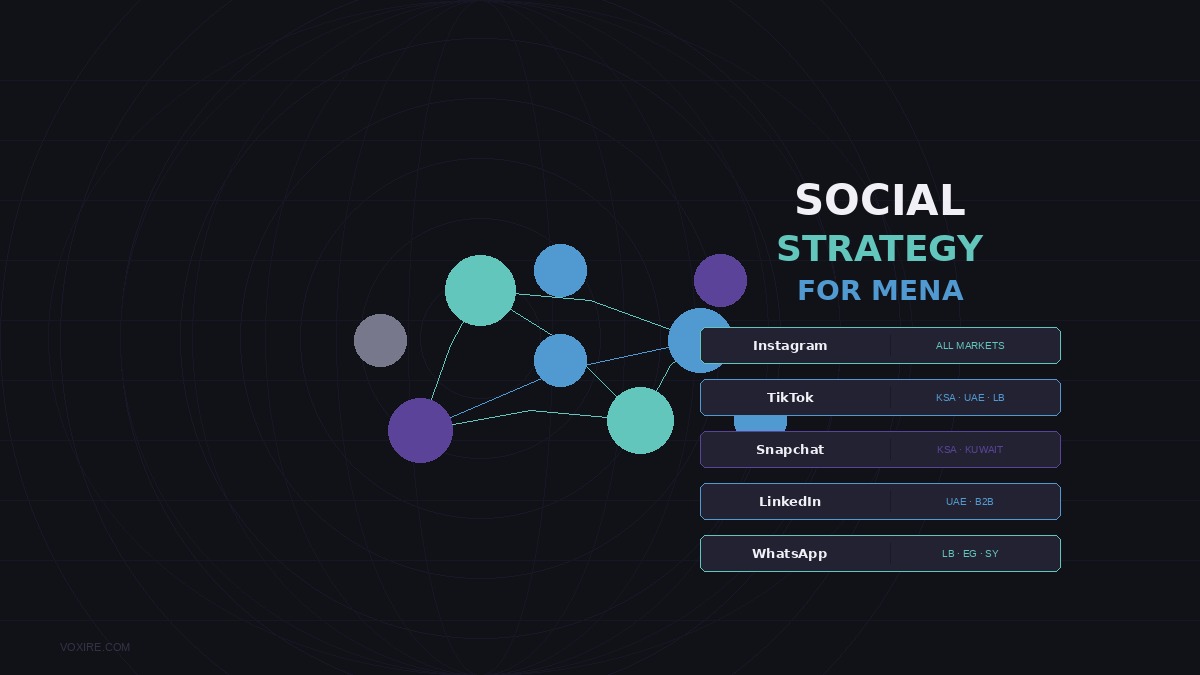
Lebanese businesses increasingly need social media strategies that work not just locally but across the MENA region. Whether you are a Beirut-based brand eyeing the Gulf market or a MENA company entering Lebanon, this guide covers how to build a strategy that travels.
Lebanese businesses increasingly need social media strategies that work not just locally but across the MENA region. Whether you are a Beirut-based brand eyeing the Gulf market or a MENA company entering Lebanon, this guide covers how to build a strategy that travels.
Why does a Lebanon-specific social media approach not scale to MENA?
Social media strategy that works in Lebanon does not automatically translate to Saudi Arabia, the UAE, or Egypt. The platforms, content preferences, regulatory environment, language registers, and consumer behaviors are meaningfully different across MENA markets.
A Lebanese food brand that built its following through witty Arabic-English code-switching content that resonates perfectly with Beirut's bilingual urban audience may find that same content falls flat with Gulf audiences who have different cultural references, different humor, and different expectations of brand communication.
Building a MENA-ready strategy requires understanding these differences from the start, not as an afterthought when you decide to expand.
Which platforms matter in which MENA markets?
Platform importance varies significantly across MENA in 2026:
Instagram is the primary aspirational and product discovery platform across almost all MENA markets: Lebanon, UAE, KSA, Egypt, Jordan, Kuwait. It is the safest bet for any MENA social media strategy.
TikTok has become essential in KSA and UAE, and is growing fast in Egypt and Lebanon. For brands targeting 18-35-year-olds anywhere in MENA, TikTok is now a must-have channel, not optional.
Snapchat is disproportionately important in Saudi Arabia and Kuwait, where daily active usage rates are among the highest in the world. A social strategy for KSA that ignores Snapchat is leaving a major audience untouched. For the tactical breakdown of Snap ad formats, costs, and what converts in MENA, see our Snapchat Ads in Lebanon and MENA: 2026 Playbook. See also: How to Set a Social Media Advertising Budget for Lebanese for the topic-specific playbook.
LinkedIn matters for B2B across MENA but is especially important for reaching professionals in UAE and KSA. UAE LinkedIn penetration is among the highest globally.
X (Twitter) remains relevant in KSA and Egypt for news, current events, and public conversations. Less relevant for direct commerce but important for brand visibility and thought leadership.
Facebook is less important for younger demographics across MENA but still reaches significant audiences in Egypt and Lebanon, particularly 35+ consumers.
YouTube has very high viewership across MENA. Long-form and short-form video content (Shorts) performs well across all major markets.
Language strategy for MENA social media
This is where most brands get it wrong. There is no single Arabic that works across MENA.
Modern Standard Arabic (MSA / Fusha) is understood across all Arabic-speaking markets and is appropriate for formal communication, product descriptions, and written content that needs to travel across borders without localization.
But social media is not formal communication. Social content performs best in the dialect of the target audience:
- Lebanese audience: Lebanese Arabic dialect or Arabic-English code-switching
- Egyptian audience: Egyptian Arabic (the most widely understood Arabic dialect due to entertainment dominance)
- Gulf (KSA/UAE/Kuwait): Gulf Arabic or MSA: Gulf consumers are less tolerant of content that feels like it was written for another market
For Lebanese brands expanding to the Gulf, the practical approach is to create a core content strategy in MSA Arabic (with English for international reach) and layer in Gulf-specific content when targeting Gulf audiences directly. Do not try to use Lebanese dialect for Gulf market campaigns, it often reads as too casual or unfamiliar.
What content performs across MENA markets?
Certain content types consistently perform well across MENA regardless of the specific market:
Behind-the-scenes authenticity. Audiences across MENA reward brands that show real people, real processes, and real moments. Polished but authentic content outperforms pure advertising.
Educational content. "How-to" content, explainers, and tutorials perform extremely well across MENA. Arab audiences have high information-seeking behavior on social media.
User-generated content (UGC). Reposting real customers using your product or service builds trust across all MENA markets. Social proof is especially powerful in high-context cultures.
Seasonal and cultural events. Ramadan content is essential across the Muslim-majority MENA markets. Ramadan campaigns that feel authentic (not performative) see significant engagement lifts. Eid content, National Day campaigns for Gulf markets, and Lebanese national occasions also present opportunities. See also: Omnichannel Marketing for Lebanese Retail for the topic-specific playbook.
Arabic-first video. Short-form video in Arabic with captions consistently outperforms the same content in English for Arabic-speaking audiences across MENA. The platform algorithms also reward content that matches the language of the target audience.
Building a paid social strategy for MENA
Organic reach alone is not sufficient for meaningful MENA expansion. Paid amplification is necessary, but the approach differs by market.
Meta's MENA targeting is sophisticated. You can target by country, city, language, interests, and behaviors specific to each MENA market. Build separate ad sets for Lebanon, UAE, KSA, and Egypt rather than running a single MENA-wide campaign: the audiences, competitors, and CPMs differ significantly.
TikTok Ads in MENA have lower CPMs than Meta in most markets as of 2026, with particularly strong performance for product discovery in KSA and UAE. The creative requirements are different: short, fast-paced, native-feeling content outperforms repurposed Instagram content.
Influencer partnerships. Micro-influencers (10,000-100,000 followers) often deliver better ROI than mega-influencers across MENA. A Lebanese influencer with strong Gulf follower demographics can be a cost-effective bridge for brands entering Gulf markets.
Measuring MENA social media performance
For a MENA social media strategy to be accountable, you need to measure beyond vanity metrics:
- Reach by market - are you actually reaching your target markets?
- Engagement rate by market - Lebanese audiences may engage more with humor, Gulf audiences more with status/aspiration content
- Click-through rate and website traffic by country - are your social posts generating real website visits?
- Conversion by market - what is the cost per lead or cost per purchase from each MENA market?
Set up separate UTM parameters and audience segments in GA4 for each MENA market you are targeting so you can see which markets are generating real business value and which are just vanity reach.
A great strategy needs consistent execution to deliver results. Voxire's digital marketing services in Lebanon cover social media strategy, content production, and paid amplification for Lebanese and MENA brands.
Need help building a MENA social media strategy?
Voxire helps Lebanese and MENA businesses build social media strategies that work across borders, combining local market knowledge with data-driven campaign management. Get in touch with us today for a strategy consultation.
Enjoying this article?
Enter your email and get a clean, formatted PDF of this article: free, no spam.
Voxire
Digital Marketing in Lebanon
Marketing for Lebanese businesses and brands selling into the Gulf. SEO, Google and Meta ads, content production, bilingual Arabic and English, and budgets sized for a market where every dollar of spend has to be defensible.
Learn more