The most common question from business owners in Lebanon with a product idea: how much does it cost to build a SaaS? The honest answer depends on specific factors. The way you scope the project determines whether the budget will hold or run out halfway through.
The most common question from business owners in Lebanon with a product idea is how much does it cost to build a SaaS. The honest answer depends on specific technical and operational factors, and the way you scope the project determines whether the budget will hold or run out halfway through. This is what actually drives SaaS development cost, and how to think about it for a business serving Lebanon and the broader MENA region.
What drives SaaS development cost
Cost is not tied to the number of screens or buttons in a product. It is driven by these compounding factors:
Business logic complexity. A simple appointment booking system is fundamentally different from a restaurant management system that handles inventory, invoicing, and analytics. More business rules mean more development time, more edge case handling, and more test coverage.
Integration requirements. Integrating one payment gateway costs far less than integrating five that support Lebanon, Saudi Arabia, and the UAE. Every external integration adds development and testing time.
Multi-tenancy requirements. A system serving one company is structurally simpler than a SaaS platform serving hundreds of companies, each with isolated data stores, separate configurations, and distinct permission structures.
Performance and reliability requirements. A product used by 100 users per day is designed differently from one handling 10,000 concurrent users.
The core cost components: team and infrastructure
A real SaaS product at minimum needs:
A backend developer to build the API, database layer, and business logic. This is the backbone of the product.
A frontend developer to build the user interface and client-side experience.
A UX/UI designer to define the product experience before a line of code is written.
DevOps expertise to set up cloud infrastructure, deployment pipelines, and monitoring.
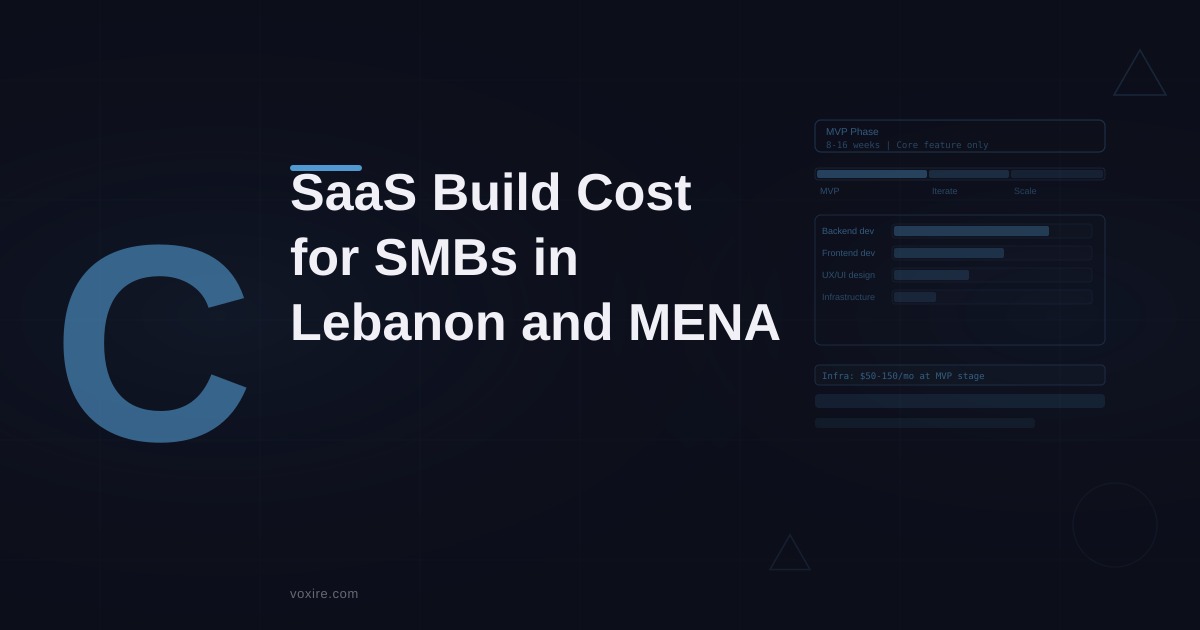
Infrastructure costs start low and grow with the product. For an MVP or pre-launch product, cloud infrastructure costs on AWS or Google Cloud typically run between $50 and $150 per month. This includes a small compute instance, a managed database, and basic storage.
At 500 to 1,000 active users, infrastructure costs may rise to $300 to $800 per month, a figure that should be covered by subscription revenue at that point.
Time estimates by phase
Phase one is the MVP. Eight to sixteen weeks for a simple to moderate product. This phase delivers only the core functionality that solves the primary problem. It is enough to test the hypothesis with early customers.
Phase two is iteration and feature expansion. After collecting customer feedback, four to eight weeks per feature set is a reasonable planning unit. This phase is driven by what customers actually need, not the original feature wishlist.
Phase three is scale and maturity. As the user base grows, priorities shift to performance, reliability, and new integrations. This phase is continuous.
Common mistakes that inflate costs
Building everything at once is the most expensive mistake. Many founders want a complete product on day one. Building 40 features before launch means spending significant budget before knowing what the market actually needs.
Changing requirements mid-build is another major cost driver. Every requirement change has a hidden cost: additional planning sessions, reworked code, repeated testing cycles. Clear requirements before development starts save significant time and money.
Choosing the wrong technology foundation costs later what it saves upfront. Building SaaS on technologies that do not scale cleanly means rewriting when the product grows. The correct technology stack costs slightly more to implement initially but saves substantially in the medium term.
Not budgeting for ongoing operations. A launched SaaS product requires ongoing costs: hosting, monitoring, customer support tooling, security updates, and new feature development. Founders who budget only for the build phase run out of runway before the product is self-sustaining.
How to control costs when building SaaS in Lebanon
Cost control does not mean compromising quality. It means prioritizing correctly.
Start with the single feature that solves a real problem customers will pay for. Not ten mediocre features, but one exceptional one that makes early customers say they cannot run their business without it.
Use existing tools where possible. There is no reason to build authentication infrastructure from scratch when mature solutions exist. There is no reason to build notification delivery infrastructure when purpose-built services are available. Every tool you adopt rather than build frees engineering time for what is genuinely unique about your product.
Price on a subscription model from day one. Predictable monthly subscriptions enable accurate cost planning. Usage-based pricing makes sense at scale, but subscriptions are easier to manage in early stages and produce steadier revenue for planning purposes.
Choose a technical partner who understands the Lebanese and MENA market. A partner who has built products for clients in Lebanon knows the payment gateway landscape, the regulatory considerations, the connectivity constraints, and the operational patterns of businesses in the region. This domain knowledge saves significant trial-and-error time.
What a realistic budget looks like for Lebanon and MENA
For a focused MVP targeting Lebanese or MENA SMBs, the engineering and design effort to reach a launchable state typically requires three to four months of work from a backend developer, frontend developer, and designer working together. Infrastructure costs during development are minimal.
Post-launch, the ongoing costs include hosting, ongoing development (to iterate based on customer feedback), and customer success. A product with meaningful revenue should be self-sustaining in terms of infrastructure costs within the first year.
The products that fail to reach sustainability are almost never failures of execution. They are failures of scope. They tried to build a product for everyone before proving it worked for anyone.
Key lessons from production
Building a SaaS product is achievable for a small company in Lebanon with a reasonable budget. The difference between a successful project and one that burns through budget before launch is requirement clarity, incremental building, and the right technical partner who understands both the technology and the market.
Ready to build your SaaS product?
Voxire builds SaaS products for SMBs across Lebanon and the MENA region. We start with core features and build incrementally based on real market feedback. Reach out at https://voxire.com/get-a-quote/
Enjoying this article?
Enter your email and get a clean, formatted PDF of this article: free, no spam.
Voxire
SaaS for MENA
SaaS built for the MENA market. Arabic-first product design, regional payment infrastructure, data residency for Saudi Arabia and the UAE, and the B2B sales motion that works in a region where the playbook from San Francisco does not.
Learn more